
AI and IoT Technologies for Power Generation Facilities
The Connectivity Foundation Beneath Every AI and IoT Solution
AI and IoT Technologies for Power Generation
Power generation facilities depend on reliable operational information generated from thousands of personnel, assets, maintenance tools, mobile equipment, spare parts, and controlled access points distributed throughout the generating station. Thermal power plants, hydroelectric generating stations, nuclear facilities, and combined cycle power plants all require industrial identification technologies that continuously establish the location and identity of critical operational resources.
GenEnergy AI provides AI and IoT technologies that combine industrial identification hardware with intelligent software to improve workforce accountability, critical asset visibility, inventory management, and operational coordination. Rather than relying solely on traditional automation systems, AI and IoT combines connected industrial devices with machine learning, Edge AI, computer vision where applicable, and enterprise software to transform identification events into meaningful operational information.
Unlike process automation systems responsible for controlling turbines, generators, boilers, excitation systems, or electrical switchgear, these technologies focus primarily on identification and location. RFID, BLE, GPS, LoRaWAN, cellular connectivity, and industrial communication technologies establish a reliable operational foundation that supports maintenance, warehouse operations, security, engineering, and plant management.
Modern generating facilities increasingly adopt hybrid identification technologies because no single wireless technology satisfies every operational requirement. Equipment operating inside turbine halls differs significantly from assets located in switchyards, coal yards, hydroelectric dams, fuel storage areas, maintenance workshops, and warehouse facilities. Selecting the appropriate technology requires consideration of operational range, environmental conditions, asset mobility, infrastructure availability, identification accuracy, installation complexity, and long-term maintenance requirements.
Physical Devices Supporting Industrial Identification
Every AI and IoT deployment begins with industrial-grade identification devices installed throughout the generating facility. These devices create digital identities for personnel, assets, maintenance equipment, inventory, and operational locations, enabling software systems to organize activities across the plant.
Unlike conventional office environments, power generation facilities demand rugged devices capable of operating under high temperatures, vibration, electromagnetic interference, dust, moisture, chemical exposure, and outdoor weather conditions.
Common identification devices include:
- Passive RFID tags
- Active RFID tags
- BLE beacons
- BLE wearable badges
- GPS asset trackers
- Cellular tracking units
- RFID handheld readers
- Fixed RFID readers
- Access control readers
- Barcode identification labels
- Mobile inspection terminals
- Industrial edge gateways
Each device performs a specialized operational role while contributing to a unified AI and IoT solution.
RFID Tags and Readers
RFID technology remains one of the most widely deployed identification solutions throughout industrial power generation facilities. Passive RFID tags provide durable identification without requiring internal batteries, making them well suited for long-term asset labeling.
Typical RFID applications include:
- Turbine component identification
- Generator component tracking
- Transformer asset identification
- Maintenance tool management
- Warehouse inventory control
- Spare parts identification
- Electrical equipment registration
- Portable instrument management
Fixed readers automatically detect tagged assets as they move through maintenance workshops, warehouses, loading areas, and controlled access points. Handheld readers provide maintenance personnel with rapid equipment verification during inspections and scheduled outages.
BLE Beacons and Wearable Devices
Bluetooth Low Energy technology provides location awareness for personnel and mobile assets operating within buildings where GPS signals are unavailable.
BLE technology commonly supports:
- Workforce location
- Contractor accountability
- Maintenance crew coordination
- Visitor location management
- Indoor equipment positioning
- Restricted work area verification
- Emergency accountability
Wearable BLE badges remain lightweight while supporting long operational lifecycles, making them appropriate for daily industrial operations.
GPS Asset Trackers
Many operational resources travel beyond the main generating facility. Maintenance vehicles, inspection equipment, portable generators, mobile cranes, trailers, and specialized repair equipment often require continuous visibility across geographically distributed utility operations.
GPS tracking devices provide outdoor location information for:
- Maintenance vehicles
- Service trucks
- Utility trailers
- Portable equipment
- Heavy lifting equipment
- Emergency response vehicles
When integrated with cellular communications, GPS systems support multi-site utility operations spanning generation facilities, substations, storage locations, and maintenance depots.
AI and RFID Technologies
RFID identification forms one of the strongest foundations for AI and IoT within power generation because it provides highly reliable identification while requiring minimal operator interaction.
AI software enhances RFID systems by identifying operational patterns across thousands of identification events without changing the underlying RFID technology itself.
Typical AI-supported RFID applications include:
- Asset utilization analysis
- Inventory movement optimization
- Maintenance workflow improvement
- Spare parts availability prediction
- Workforce movement analysis
- Equipment assignment optimization
- Contractor access verification
- Warehouse operational efficiency
Large generating facilities often process millions of RFID events annually. AI applications organize these records into operational recommendations that help engineering, maintenance, warehouse, and security teams improve decision-making.
RFID remains particularly effective for:
- Turbine overhaul activities
- Warehouse inventory
- Maintenance workshops
- Spare parts storage
- Component identification
- Tool management
- Material staging areas
AI and BLE Technologies
BLE provides accurate indoor positioning capabilities where satellite-based navigation cannot operate effectively. AI applications analyze historical location information generated by BLE systems to improve operational coordination throughout the generating station.
Power generation facilities commonly deploy BLE technologies for:
- Workforce accountability
- Contractor coordination
- Visitor management
- Maintenance team deployment
- Emergency response coordination
- Restricted area verification
- Equipment location assistance
AI software processes historical movement information to identify operational trends such as workforce congestion, frequently visited maintenance locations, recurring travel paths, and staffing allocation patterns.
These operational insights assist plant managers during planned maintenance outages and routine operations without interfering with normal workforce activities.
BLE deployments are especially valuable within:
- Turbine halls
- Generator buildings
- Maintenance workshops
- Control buildings
- Administration facilities
- Warehouse interiors
- Training centers
AI and LoRaWAN Technologies
LoRaWAN enables long-range, low-power wireless communications across extensive industrial facilities where conventional short-range wireless technologies may not provide adequate coverage.
Power generation organizations often operate geographically dispersed assets that require reliable communications across outdoor environments.
Typical LoRaWAN deployment areas include:
- Coal yards
- Ash handling facilities
- Fuel storage terminals
- Hydroelectric reservoirs
- Dam infrastructure
- Water intake facilities
- Utility storage areas
- Remote maintenance buildings
Within AI and IoT solutions, LoRaWAN provides dependable communications between distributed industrial devices and centralized software.
AI applications utilize operational records transmitted through LoRaWAN to improve:
- Remote asset visibility
- Maintenance scheduling
- Operational resource allocation
- Field workforce coordination
- Distributed equipment management
Unlike high-bandwidth communication technologies, LoRaWAN emphasizes dependable long-distance communication while minimizing infrastructure complexity and energy consumption.
AI and GPS with Cellular Technologies
Power generation companies often manage assets and personnel beyond the boundaries of a single generating station. Utility fleets travel between generating plants, substations, maintenance depots, transmission facilities, warehouses, and contractor work locations. GPS combined with cellular communications provides continuous visibility for mobile resources operating across geographically distributed service territories.
Unlike RFID and BLE, which primarily support local identification and indoor positioning, GPS determines outdoor geographic location while cellular networks transmit operational information over long distances. Together, these technologies support coordinated utility operations across multiple sites without requiring extensive local communications infrastructure.
Common applications include:
- Utility maintenance vehicle tracking
- Mobile crane location
- Portable generator management
- Emergency response fleet coordination
- Mobile maintenance equipment tracking
- Contractor vehicle verification
- Inter-facility asset transfers
- Remote inspection team coordination
AI software processes historical travel records and operational activity to improve fleet utilization, optimize dispatch decisions, identify frequently used routes, and enhance maintenance scheduling for mobile assets. These capabilities help reduce unnecessary equipment movement while improving resource availability during planned outages and emergency restoration activities.
For utilities operating multiple generating stations, GPS and cellular technologies contribute to consistent operational visibility across an entire regional network.
Selecting the Right Wireless Technology for Power Generation
Every operational area within a generating facility presents different technical and environmental requirements. A successful AI and IoT deployment combines several complementary technologies rather than relying on a single wireless solution.
Technology selection depends on factors such as:
- Required identification accuracy
- Indoor or outdoor deployment
- Communication range
- Environmental conditions
- Asset mobility
- Infrastructure availability
- Battery life requirements
- Installation complexity
- Expansion capability
- Regulatory and cybersecurity considerations
Turbine Halls
Turbine halls contain high-value rotating equipment, maintenance activities, and authorized personnel working within controlled environments. Identification technologies should provide reliable indoor performance while supporting maintenance coordination and asset accountability.
Common technology choices include:
- RFID for component identification
- BLE for workforce location
- Access control readers for authorized entry
- Mobile RFID readers for maintenance verification
Switchyards and Outdoor Utility Areas
Outdoor electrical infrastructure requires technologies capable of operating across large open areas while withstanding weather exposure.
Suitable technologies include:
- GPS for mobile assets
- LoRaWAN for distributed communications
- RFID for fixed asset identification
- Cellular connectivity for remote equipment
Spare Parts Warehouses
Warehouse operations require rapid identification of inventory, tools, replacement components, and maintenance materials.
Common deployments include:
- Passive RFID inventory identification
- Fixed RFID portals
- Handheld RFID readers
- Barcode systems where appropriate
- BLE location for mobile warehouse equipment
Control Rooms and Secure Operational Areas
Access management remains the primary operational requirement for highly restricted facilities.
Typical technologies include:
- RFID credentials
- Smart access readers
- BLE personnel identification
- Digital visitor credentials
- Integrated access management software
Selecting technologies according to operational requirements improves long-term reliability while minimizing deployment complexity.
Supporting Enterprise AI and IoT Solutions
Industrial identification technologies generate the operational information required by higher-level AI software. Every personnel movement, asset transfer, inventory transaction, maintenance activity, and access event contributes to a structured operational record that can support engineering analysis and informed decision-making.
GenEnergy AI solutions distinguish between technology responsible for data collection and software responsible for advanced analysis. Identification devices capture operational events, communication technologies securely transport those events, IoT software organizes operational records, and AI software applies machine learning and Edge AI to identify trends, recommend actions, and improve operational planning.
This layered approach allows organizations to modernize gradually while preserving existing investments in industrial identification infrastructure.
Applications Across Power Generation Facilities
AI-enhanced wireless technologies support a broad range of operational activities across thermal, hydroelectric, nuclear, and combined cycle power generation facilities.
Representative applications include:
- Turbine rotor identification during major overhauls
- Generator maintenance tool accountability
- Spare parts warehouse inventory management
- Contractor access verification
- Control room entry authorization
- Mobile maintenance vehicle tracking
- Utility fleet coordination
- Portable equipment location
- Warehouse material transfers
- Outage workforce accountability
- Component lifecycle documentation
- Multi-site asset management
These applications improve operational visibility while supporting maintenance planning, engineering documentation, workforce coordination, warehouse efficiency, and regulatory compliance.
Engineering Experience Supporting Industrial Deployments
Successful implementation of industrial identification technologies requires practical engineering experience in addition to product knowledge. Power generation facilities demand reliable operation under challenging environmental conditions while maintaining compatibility with existing operational procedures and enterprise software.
GenEnergy AI benefits from extensive industrial experience gained through GAO’s work across critical infrastructure sectors. Continuous investment in research and development, rigorous quality assurance, and comprehensive technical support enable the company to deliver solutions designed for demanding utility environments.
Led by Ph.D. professionals and supported by experienced engineering teams, GenEnergy AI combines technical research with practical implementation knowledge. This expertise has been strengthened through collaborations with Fortune 500 organizations, research institutions, universities, and government agencies across North America, helping ensure that deployed solutions address real operational challenges rather than theoretical requirements.
Build a Strong Technology Foundation for AI and IoT
Reliable AI begins with reliable identification. RFID, BLE, LoRaWAN, GPS, cellular communications, and industrial connectivity technologies establish the operational foundation required for workforce accountability, asset tracking, inventory management, access control, and maintenance traceability across modern power generation facilities.
GenEnergy AI helps utilities deploy the appropriate combination of industrial identification technologies for each operational environment, creating dependable operational records that support AI-driven decision-making without disrupting existing plant operations. By combining proven industrial hardware with enterprise software and advanced AI capabilities, organizations can improve operational efficiency, equipment availability, workforce coordination, and long-term asset management while maintaining the reliability expected within critical power generation infrastructure.
GenEnergy AI and IoT Solution Overview for Power Generation Facilities
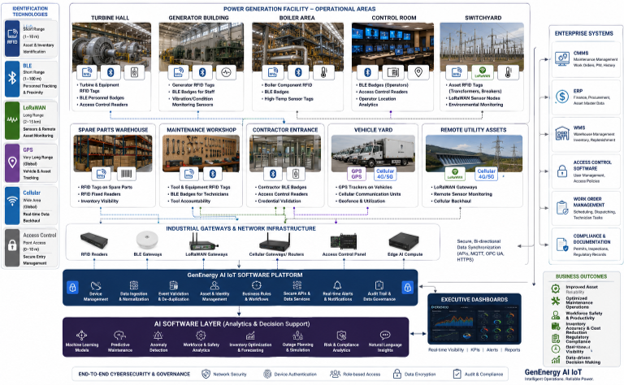
This solution overview maps how RFID, BLE, LoRaWAN, GPS, cellular, and access control technologies connect operational areas such as turbine halls, generator buildings, boiler areas, warehouses, workshops, vehicle yards, and remote utility assets. GenEnergy AI IoT software organizes identification and location data before integrating with CMMS, ERP, WMS, access control, work order, and compliance systems, while the AI software layer supports analytics, maintenance decisions, workforce safety, inventory optimization, and executive reporting.
AI and GPS & Cellular Technologies for Mobile Power Generation Operations
Power generation organizations often operate well beyond the boundaries of a single generating station. Utility companies manage mobile maintenance crews, inspection vehicles, emergency response fleets, portable generators, mobile substations, and temporary equipment deployed across transmission corridors, hydroelectric facilities, renewable energy sites, and thermal generation plants. AI and IoT systems using GPS, GNSS, LTE, 5G, NB-IoT, and satellite communications provide continuous location visibility for these mobile resources while supporting operational planning and workforce coordination.
Unlike RFID and BLE technologies that primarily operate within defined facilities, GPS and cellular technologies extend visibility across geographically dispersed operations. AI analyzes movement history, travel routes, dispatch priorities, geofenced operational boundaries, and equipment utilization to improve logistics while ensuring critical assets remain available where they are needed most.
Power generation organizations frequently combine GPS tracking with RFID and BLE identification technologies to maintain uninterrupted visibility as assets move between warehouses, maintenance facilities, substations, turbine halls, switchyards, and remote field locations.
Mobile Workforce Coordination
Large utilities coordinate hundreds or thousands of maintenance personnel during planned outages, transmission inspections, vegetation management, equipment commissioning, and emergency restoration activities.
AI-assisted GPS solutions help organizations:
- Track maintenance vehicles traveling between multiple generating stations
- Monitor contractor arrival and departure times
- Improve dispatch efficiency for emergency response teams
- Reduce unnecessary travel
- Optimize technician scheduling
- Coordinate outage maintenance activities
- Verify work completion locations
- Improve workforce accountability
Location information supports operational decision making while helping supervisors allocate resources more effectively during both routine maintenance and unexpected events.
Remote Asset Visibility
Many critical assets remain outside primary generating facilities.
Examples include:
- Portable transformers
- Mobile generators
- Temporary switchgear
- Inspection trailers
- Specialized maintenance equipment
- Utility vehicles
- High-value diagnostic instruments
- Mobile communication systems
AI evaluates equipment utilization patterns, transportation history, and deployment frequency to recommend improved allocation across multiple facilities.
Organizations reduce equipment losses while improving utilization of expensive mobile assets.
Selecting Wireless Technologies for Different Power Generation Environments
No single wireless technology satisfies every operational requirement inside a modern generating facility. Successful AIoT deployments typically combine multiple identification and communication technologies according to environmental conditions, operational workflows, asset mobility, and security requirements.
01.
Turbine Halls
Turbine halls contain large rotating equipment, high temperatures, vibration, metallic infrastructure, and electromagnetic interference.
Recommended technologies include:
- Industrial RFID
- BLE beacons
- Rugged access control readers
- Industrial Wi-Fi
- Edge AI processing
- Industrial Ethernet integration
02.
Boiler Areas
Boiler operations require durable identification technologies capable of functioning in challenging industrial environments.
Common deployments include:
- High-temperature RFID tags
- Industrial handheld RFID readers
- Rugged BLE devices
- Restricted access credential systems
- Equipment identification labels
- Mobile maintenance terminals
03.
Nuclear Facilities
Nuclear generating stations demand exceptionally high security, regulatory compliance, and operational accountability.
Typical technologies include:
- Secure encrypted RFID credentials
- Multi-factor access control
- Personnel location systems
- Visitor authorization systems
- Critical equipment identification
- Audit logging software
Technology selection emphasizes regulatory compliance, cybersecurity, redundancy, and reliability.
04.
Hydroelectric Plants
Hydroelectric facilities often span extensive geographic areas that include dams, spillways, tunnels, intake structures, generating units, switchyards, and maintenance buildings.
Suitable technologies include:
- Long-range RFID
- BLE positioning
- GPS fleet tracking
- Cellular communications
- LoRaWAN connectivity
- Rugged mobile terminals
05.
Spare Parts Warehouses
Warehouse operations benefit from identification technologies optimized for inventory accuracy and logistics efficiency.
Frequently deployed technologies include:
- Passive RFID
- Fixed RFID portals
- Handheld RFID readers
- BLE asset tags
- Barcode integration
- Warehouse management software
These technologies improve inventory visibility while reducing manual inventory counts and locating critical maintenance components faster.
Choosing the Right AI and IoT Technology Combination
Technology selection should begin with operational objectives rather than hardware preferences. Each generating facility has different workflows, environmental conditions, maintenance practices, regulatory obligations, and cybersecurity requirements. A carefully planned combination of identification technologies delivers significantly better long-term value than deploying a single wireless solution across every operational area.
Factors commonly evaluated include:
- Required positioning accuracy
- Asset mobility
- Personnel safety requirements
- Environmental conditions
- Read range
- Battery life
- Installation complexity
- Cybersecurity requirements
- Integration with existing software
- Regulatory compliance
- Scalability across multiple facilities
- Maintenance requirements
- Total cost of ownership
Organizations frequently adopt hybrid deployments combining RFID, BLE, LoRaWAN, GPS, cellular communications, and existing industrial communication systems to address varying operational requirements throughout power generation facilities
How AI and IoT Software Differs from Industrial Connectivity
Industrial connectivity software focuses on transferring operational information between enterprise systems, equipment, and field devices. AI and IoT software builds upon those connections by applying advanced analytics that transform operational information into practical recommendations.
Within power generation facilities, AI and IoT software can:
- Identify operational trends across multiple generating units
- Recommend maintenance priorities based on historical records
- Detect unusual workforce movement patterns
- Improve allocation of maintenance resources
- Optimize spare parts planning
- Support engineering decision making
- Strengthen operational reporting
This analytical layer enables organizations to derive greater value from existing operational information while improving overall decision quality.
Supporting Reliable AI and IoT Deployments for Power Generation
GenEnergy AI was created within Aperture Venture Studio with support from GAO, building upon practical experience gained through thousands of industrial IoT deployments across energy and utility operations. Extensive investment in research, engineering validation, and quality assurance helps ensure solutions remain reliable under demanding operating conditions found in thermal, hydroelectric, renewable, and nuclear power facilities.
Engineering teams led by Ph.D. professionals work alongside experienced IoT specialists to develop identification and location solutions that integrate with existing operational software while supporting stringent cybersecurity, regulatory, and operational requirements. Remote and onsite technical support assists organizations throughout planning, deployment, system validation, expansion, and long-term operation.
Power producers, utility operators, engineering organizations, research institutions, Fortune 500 companies, and government agencies continue adopting AI and IoT technologies to improve personnel accountability, equipment visibility, maintenance coordination, inventory management, and operational reliability across increasingly complex power generation environments.
Applications Across Power Generation Facilities
AI and IoT identification and wireless communication technologies support a broad range of operational scenarios, including:
- Thermal power plant workforce accountability
- Nuclear access authorization
- Hydroelectric maintenance coordination
- Gas turbine asset identification
- Steam turbine overhaul management
- Boiler maintenance logistics
- Generator component tracking
- Switchyard equipment visibility
- Major outage coordination
- Coal yard personnel safety
- Renewable energy maintenance operations
- Spare parts warehouse management
- Mobile maintenance fleet tracking
- Contractor management
- Emergency response coordination
- Multi-site utility operations
- Regulatory compliance documentation
- Asset lifecycle management
These technologies establish the reliable identification, connectivity, and location foundation required for advanced AI-driven operational software across modern power generation facilities.
Applicable U.S. and Canadian Standards and Regulations for AI and IoT Power Generation Technologies
Organizations implementing AI and IoT identification, location, access control, asset tracking, inventory management, and maintenance traceability solutions in power generation facilities should consider compliance with applicable industry, cybersecurity, electrical, occupational safety, and nuclear regulations. Requirements vary depending on whether the facility is thermal, hydroelectric, nuclear, renewable, or utility operated.
U.S. Standards and Regulations
- NERC CIP (North American Electric Reliability Corporation Critical Infrastructure Protection Standards)
- NERC Reliability Standards
- FERC Critical Infrastructure Protection Requirements
- OSHA 29 CFR 1910
- OSHA Permit-Required Confined Spaces (29 CFR 1910.146)
- OSHA Process Safety Management (29 CFR 1910.119)
- NFPA 70 National Electrical Code (NEC)
- NFPA 70E Standard for Electrical Safety in the Workplace
- NFPA 850 Recommended Practice for Fire Protection for Electric Generating Plants
- NFPA 855 Standard for the Installation of Stationary Energy Storage Systems
- ANSI/ISA-62443 Industrial Automation and Control Systems Security
- IEC 62443 Industrial Cybersecurity Series
- IEC 61850 Communication Networks and Systems for Power Utility Automation
- IEEE 1686 Intelligent Electronic Device Cybersecurity Standard
- IEEE 1815 (DNP3)
- IEEE C37 Series
- IEEE 1588 Precision Time Protocol
- ISO/IEC 27001 Information Security Management Systems
- ISO/IEC 27017 Cloud Security
- ISO/IEC 27018 Privacy Protection
- ISO 55001 Asset Management Systems
- ISO 9001 Quality Management Systems
- ISO 31000 Risk Management
- ISO 45001 Occupational Health and Safety Management Systems
- ISO 14224 Reliability and Maintenance Data
- ISA-95 Enterprise-Control System Integration
- ISA-88 Batch Control Standard (where applicable)
- NIST Cybersecurity Framework (CSF)
- NIST SP 800-53
- NIST SP 800-82 Guide to Industrial Control Systems Security
- NIST AI Risk Management Framework (AI RMF 1.0)
- NRC 10 CFR Part 50 (Nuclear Facilities)
- NRC 10 CFR Part 73 (Physical Protection of Plants and Materials)
- NRC Regulatory Guides applicable to digital systems and cybersecurity
Canadian Standards and Regulations
- Canadian Electrical Code (CSA C22.1)
- CSA Z462 Workplace Electrical Safety
- CSA Z1000 Occupational Health and Safety Management
- CSA Z246 Asset Management
- CSA N290 Series (Nuclear Power Plants)
- CSA N293 Fire Protection for Nuclear Facilities
- CSA N286 Management System Requirements for Nuclear Facilities
- CSA C282 Emergency Electrical Power Supply
- CSA C22.2 Standards
- Canadian Nuclear Safety Commission (CNSC) Regulations
- Canadian Centre for Cyber Security Industrial Control Systems Guidance
- Canadian Centre for Cyber Security Baseline Cyber Security Controls
- Provincial Occupational Health and Safety Regulations
- Provincial Electrical Safety Codes
- ISO/IEC 27001
- ISO 55001
- IEC 62443
- IEC 61850
- IEEE 1686
- NERC CIP (applicable across North American Bulk Electric System operators)
Leading Companies Delivering AI and IoT Technologies for Power Generation
Modern AI and IoT deployments for power generation frequently integrate hardware, industrial software, identification technologies, wireless communications, cybersecurity, and operational systems from multiple technology providers. Organizations typically select vendors according to plant type, regulatory requirements, existing infrastructure, and long-term maintenance strategies.
Industrial Automation and Power Generation
- Siemens Energy
- Siemens
- GE Vernova
- Schneider Electric
- ABB
- Emerson
- Honeywell
- Rockwell Automation
- Mitsubishi Electric
- Hitachi Energy
- Yokogawa Electric
- Toshiba Energy Systems & Solutions
- Eaton
- Phoenix Contact
- WAGO
Asset Tracking and Maintenance Software
- IBM
- SAP
- Oracle
- AVEVA
- Hexagon
- IFS
- Infor
- GE Vernova
- ABB
- Siemens
RFID and Identification Technologies
- Zebra Technologies
- HID Global
- Impinj
- Avery Dennison
- SICK
- Balluff
- PepperlandFuchs
- Turck
- Confidex
- Checkpoint Systems
Industrial Wireless Communications
- Cisco
- HPE Aruba Networking
- Ericsson
- Nokia
- Semtech
- MultiTech Systems
- Digi International
- Moxa
- Advantech
- Lantronix
BLE and Real-Time Location Solutions
- Kontakt.io
- Quuppa
- Minew
- BlueCats
- HID Global
- Litum
- CenTrak
- AiRISTA Flow
Industrial Edge Computing and AI Computing
- NVIDIA
- Intel
- Dell Technologies
- Hewlett Packard Enterprise
- Advantech
- AAEON
- OnLogic
- Supermicro
Access Control and Physical Security
- Genetec
- LenelS2
- Johnson Controls
- Bosch Security Systems
- Gallagher Security
- Honeywell
- dormakaba
- Suprema
- Axis Communications
- HID Global
Utility Communications and Power System Solutions
- SEL (Schweitzer Engineering Laboratories)
- Hitachi Energy
- GE Vernova Grid Solutions
- Siemens Grid Software
- Cisco
- Nokia
- Ericsson
Why Organizations Choose GenEnergy AI
GenEnergy AI develops AI and IoT software and identification solutions specifically for power generation environments where workforce accountability, access authorization, asset identification, spare parts visibility, and maintenance traceability directly affect operational reliability and regulatory compliance.
Created within Aperture Venture Studio with support from GAO, GenEnergy AI benefits from more than two decades of industrial IoT experience gained through thousands of customer engagements and deployment projects. Extensive research and development, rigorous quality assurance, and technical support delivered remotely or onsite help organizations integrate RFID, BLE, LoRaWAN, GPS, and cellular technologies with existing operational software while minimizing deployment risks.
Engineering leadership from Ph.D. professionals, together with collaboration across industry experts, research organizations, Fortune 500 companies, universities, and government agencies in the United States and Canada, supports practical AI and IoT solutions that address the operational requirements of thermal power plants, hydroelectric stations, nuclear generating facilities, renewable energy sites, and utility operators.
GenEnergy AI focuses on identification and location solutions that strengthen personnel safety, controlled facility access, equipment visibility, spare parts management, maintenance documentation, and regulatory readiness while providing reliable data for higher-level AI software and operational decision support.
Case Studies
Phoenix, Arizona, USA
AI and RFID Workforce Identification and Critical Asset Tracking for a Thermal Power Generation Facility
- Problem
A large thermal power generation facility in Phoenix was preparing for a scheduled turbine overhaul involving several hundred internal employees, contractors, inspection personnel, and maintenance specialists. Multiple work crews were simultaneously assigned to turbine halls, boiler areas, control rooms, switchyards, warehouse facilities, and restricted electrical zones.
Manual personnel check-in procedures created delays during shift changes, while paper-based contractor verification increased administrative workload. Maintenance supervisors also experienced difficulty locating specialized tooling, portable testing equipment, lifting accessories, calibration instruments, and high-value maintenance assets distributed across the facility. Spare parts stored in multiple warehouse locations required manual reconciliation before maintenance work could proceed, extending outage schedules.
The organization sought an AI and IoT solution emphasizing personnel identification, access authorization, asset tracking, inventory visibility, and maintenance traceability without replacing existing maintenance management software.
- Solution
GenEnergy AI designed and deployed an AIoT identification and location solution focused on workforce accountability and maintenance logistics.
Drawing upon implementation experience developed through GAO Tek Inc. and GAO RFID Inc., we integrated several complementary identification technologies throughout the generating station.
The deployment included:
- UHF RFID readers positioned at maintenance entry points
- Passive UHF RFID tags attached to maintenance tools and portable equipment
- RFID antennas covering warehouse receiving and issue stations
- BLE beacons supporting personnel location inside maintenance zones
- BLE gateways installed throughout turbine halls
- RFID-enabled contractor identification badges
- Industrial edge computing devices for local processing
- Cellular IoT devices supporting temporary maintenance locations
AI software correlated RFID events, BLE location updates, maintenance work orders, and warehouse transactions into a unified operational view.
Personnel entering restricted electrical work areas were automatically verified against work authorization records before access approval. Contractor movements between turbine buildings, maintenance workshops, and warehouse facilities were continuously documented without manual sign-in procedures.
High-value maintenance equipment was automatically identified whenever moved through RFID-controlled checkpoints. Warehouse personnel could quickly locate specialized lifting equipment, portable vibration analyzers, alignment systems, welding equipment, and calibration instruments required for outage work.
RFID identification also improved spare parts issuance by validating component movement between storage locations and active maintenance teams.
Our engineers integrated GAO RFID UHF Readers, RFID Antennas, RFID Reader Modules, BLE Gateways, BLE Beacons, RFID Accessories, and Industrial Edge Computing devices into the existing operational software while minimizing disruption to scheduled outage activities.
- Result
The deployment improved workforce accountability throughout the outage while significantly reducing manual identification activities.
Measured operational improvements included:
- Approximately 82% faster contractor check-in
- Approximately 55% reduction in maintenance equipment search time
- Improved visibility of portable maintenance assets
- Faster warehouse issue processing
- Better documentation of restricted-area access
- More accurate maintenance traceability
- Reduced manual inventory reconciliation
- Improved outage coordination across multiple work teams
The largest measurable improvement was the approximately 82% reduction in contractor processing time during shift changes.
- Lesson Learned
Large thermal generating stations benefit from combining RFID identification with BLE location technologies instead of relying on a single wireless method. RFID delivers reliable asset identification while BLE improves personnel visibility inside complex maintenance environments.
Pittsburgh, Pennsylvania, USA
AI and BLE Personnel Accountability and Access Control for Fossil Fuel Power Plant Maintenance
- Problem
A fossil fuel generating station performing major boiler rehabilitation needed better visibility of maintenance personnel working across multiple restricted operational areas.
Hundreds of employees and contractors moved daily between boiler structures, electrical rooms, control centers, warehouse facilities, and temporary maintenance compounds. Supervisors relied heavily on manual attendance records, radio communication, and spreadsheet updates to determine personnel locations during shift changes and emergency drills.
Portable inspection equipment frequently changed work locations during outage activities, making utilization reporting difficult. Spare parts requested by maintenance crews occasionally remained in warehouse staging locations because personnel could not easily verify delivery status.
Plant management requested an AI and IoT solution emphasizing people tracking, secure access management, equipment identification, and warehouse visibility without disrupting ongoing maintenance operations.
- Solution
GenEnergy AI implemented an integrated AI and BLE and AI and RFID identification solution supported by technologies supplied through GAO Tek Inc. and GAO RFID Inc.
The deployment incorporated:
- BLE beacons assigned to maintenance personnel
- BLE gateways covering maintenance work areas
- RFID employee credentials
- RFID access readers protecting restricted electrical rooms
- UHF RFID tags attached to portable maintenance equipment
- GPS IoT trackers assigned to mobile maintenance trailers
- Cellular IoT communication devices supporting temporary work locations
- Industrial edge computing systems performing local event processing
BLE location software continuously identified workforce movement throughout authorized operational zones while RFID credentials validated personnel access at secured entry points.
AI software analyzed movement patterns to identify staffing distribution, congested maintenance areas, unauthorized movement attempts, delayed response during emergency exercises, and equipment utilization.
Warehouse operations were enhanced using RFID identification for spare parts movement. Maintenance supervisors gained improved visibility of component availability before dispatching technicians to work locations.
GPS IoT tracking devices monitored mobile maintenance trailers transporting specialized equipment between warehouse facilities and temporary outage support areas.
GAO RFID UHF Readers, RFID Tags, BLE Products, BLE Gateways, GPS IoT Devices, Cellular IoT Devices, and Edge Computing hardware were integrated with existing operational software to establish a unified identification and location solution.
Our implementation teams also assisted with reader positioning, radio coverage optimization, RFID tag selection, BLE calibration, user training, and deployment validation.
- Result
Personnel accountability improved substantially during outage maintenance activities while equipment identification became significantly more efficient.
Operational improvements included:
- Approximately 67% faster emergency personnel accountability
- Approximately 48% reduction in time required to locate portable maintenance assets
- Improved warehouse inventory visibility
- Faster access authorization
- Reduced manual attendance documentation
- Better maintenance coordination
- Improved contractor management
- Enhanced maintenance traceability
The most significant measurable improvement was an approximately 67% reduction in emergency accountability time during evacuation exercises.
- Lesson Learned
Combining BLE personnel location with RFID-based identification provides greater operational reliability than using either technology independently. AI software becomes more valuable when accurate identification events from multiple wireless technologies are correlated into a single operational workflow.
Richland, Washington, USA
AI and RFID Asset Identification and Maintenance Traceability for a Nuclear Power Generation Facility
- Problem
A nuclear power generation facility in Richland required stronger control over personnel identification, access authorization, maintenance traceability, and movement of safety-related equipment during a planned refueling outage. Thousands of maintenance activities involving employees, contractors, inspectors, and specialized service providers had to be completed within a tightly controlled outage schedule while maintaining complete documentation for regulatory compliance.
Manual verification of personnel credentials at multiple protected areas increased processing time during shift changes. Portable maintenance equipment, inspection instruments, radiological support equipment, and specialized tooling frequently moved between controlled work locations, making asset accountability difficult. Warehouse personnel also required improved visibility of critical spare parts supporting reactor maintenance and turbine-generator overhaul activities.
The organization wanted an AI and IoT solution centered on identification and location technologies that could integrate with existing maintenance software while strengthening operational accountability and documentation.
- Solution
GenEnergy AI designed an AI and RFID and AI and BLE identification solution using implementation experience developed through numerous industrial identification projects supported by GAO Tek Inc. and GAO RFID Inc.
Our engineering team deployed a combination of:
- UHF RFID Readers positioned at protected area entry points
- UHF RFID Tags assigned to maintenance assets and portable tooling
- HF RFID credential readers supporting secure employee identification
- RFID antennas covering warehouse receiving and issue locations
- BLE Beacons assigned to maintenance supervisors and outage coordinators
- BLE Gateways installed throughout designated maintenance work zones
- Biometric devices integrated with secure access verification
- Device Edge computing hardware providing local event processing
- Cellular IoT devices supporting temporary outage work locations
RFID identification verified maintenance assets whenever equipment entered or exited controlled maintenance zones. Personnel credentials were validated before access approval, while AI software correlated identification events with maintenance work orders, authorized work packages, contractor assignments, and equipment movement history.
BLE location information helped outage coordinators understand workforce distribution across turbine halls, maintenance workshops, warehouse facilities, and authorized work areas. Portable inspection equipment, lifting devices, calibration instruments, and maintenance tooling could be located without manual searches.
Warehouse operations benefited from RFID-assisted inventory visibility, reducing delays associated with locating specialized replacement components required during scheduled maintenance.
Our deployment incorporated GAO RFID UHF Readers, HF Readers, RFID Reader Modules, RFID Antennas, BLE Products, BLE Gateways, Biometric Devices, and Device Edge hardware. We also assisted with RFID tag selection, access reader placement, radio frequency validation, software integration, commissioning support, and operator training.
- Result
The AI and IoT solution strengthened identification accuracy while improving maintenance documentation and equipment accountability.
Operational outcomes included:
- Approximately 61% faster controlled-area personnel verification
- Approximately 53% reduction in maintenance equipment search time
- Improved asset movement documentation
- Better spare parts visibility during outage maintenance
- Faster contractor credential validation
- Improved maintenance traceability
- More complete audit documentation
- Better coordination between warehouse and maintenance teams
The most significant measurable improvement was an approximately 61% reduction in personnel verification time for controlled maintenance areas during scheduled outage activities.
- Lesson Learned
Highly regulated power generation facilities benefit from combining RFID identification, BLE location services, and biometric verification. Multiple identification technologies improve operational resilience while simplifying maintenance documentation and regulatory reporting.
Pickering, Ontario, Canada
AI and BLE Workforce Location and RFID Inventory Management for a Power Generation Facility
- Problem
A Canadian power generation facility operating multiple generating units required improved visibility of maintenance personnel, contractors, warehouse inventory, and mobile maintenance assets distributed across turbine buildings, electrical workshops, spare parts warehouses, maintenance staging areas, and secured operational zones.
Maintenance teams frequently relocated specialized testing equipment, portable communication systems, calibration devices, and temporary lifting equipment during scheduled maintenance campaigns. Manual inventory reconciliation delayed work package completion because warehouse personnel required additional time to confirm component availability.
Facility management also wanted better contractor accountability during major maintenance periods while maintaining compatibility with existing maintenance management software and operational procedures.
The objective was to deploy an AI and IoT identification solution emphasizing workforce accountability, access management, equipment identification, inventory visibility, and maintenance traceability.
- Solution
GenEnergy AI implemented an integrated AI and BLE, AI and RFID, and GPS-enabled identification solution based on practical deployment methodologies developed through GAO Tek Inc. and GAO RFID Inc.
The deployment included:
- BLE Gateways installed throughout maintenance buildings
- BLE Beacons assigned to maintenance personnel and contractors
- UHF RFID Readers positioned at warehouse logistics checkpoints
- Passive RFID Tags attached to portable maintenance equipment
- RFID Antennas covering warehouse shipping and receiving operations
- GPS IoT Trackers assigned to mobile maintenance vehicles
- Cellular IoT Devices supporting field maintenance activities
- On Premise Edge computing hardware performing local processing
BLE location services improved workforce accountability by documenting personnel movement across authorized operational areas. RFID automatically identified maintenance equipment entering warehouse facilities, staging areas, and designated maintenance zones.
AI software analyzed identification records, workforce movement, warehouse transactions, equipment utilization history, and maintenance schedules to improve operational planning without replacing existing maintenance software.
Warehouse teams benefited from improved visibility of maintenance inventory, critical spare parts, replacement components, and portable assets supporting planned outages. GPS tracking provided additional visibility for maintenance vehicles transporting equipment between multiple operating locations.
Our implementation teams supported reader installation, BLE calibration, RFID validation testing, software integration, deployment verification, user training, and long-term technical assistance. GAO RFID hardware, BLE Products, UHF Readers, RFID Tags, GPS IoT Trackers, Cellular IoT Devices, and Edge Computing systems were incorporated according to operational requirements.
- Result
The deployment improved workforce accountability, inventory visibility, and maintenance coordination across multiple operating areas.
Measured improvements included:
- Approximately 58% faster identification of maintenance assets
- Approximately 46% reduction in warehouse inventory search time
- Improved contractor accountability
- Better workforce visibility during scheduled maintenance
- Faster spare parts verification
- Improved equipment utilization reporting
- More complete maintenance traceability
- Better coordination between warehouse and field maintenance personnel
The most significant measurable improvement was an approximately 58% reduction in maintenance asset identification time, improving maintenance efficiency during scheduled outages.
- Lesson Learned
Power generation organizations operating multiple maintenance locations benefit from combining BLE personnel location, RFID asset identification, GPS fleet visibility, and AI-assisted workflow analysis. A hybrid identification approach improves operational efficiency while preserving compatibility with existing maintenance software and established work practices.