IoT Software for AIoT-Enabled Power Plant
Connecting Personnel, Assets, and Plant Operations Through Industrial IoT Software
IoT Software for Power Generation Facilities
Power generation facilities rely on accurate operational information to maintain safe, reliable, and efficient electricity production. Every maintenance activity, workforce movement, equipment transfer, spare parts transaction, and access event generates valuable operational records that support plant management and long-term asset reliability. Transforming these records into structured, accessible information requires industrial IoT software designed specifically for the operational requirements of thermal power stations, nuclear generating facilities, hydroelectric plants, combined cycle gas turbine (CCGT) stations, and cogeneration facilities.
GenEnergy AI provides IoT software that captures, validates, organizes, and distributes operational information from identification and location technologies across the power generation environment. Rather than performing advanced analytical processing, this software establishes the trusted operational data foundation that enables AI and IoT applications to generate recommendations, optimize workflows, and improve operational decision-making.
Artificial Intelligence of Things, commonly referred to as AIoT or AI and IoT, combines artificial intelligence with connected industrial devices, RFID technology, BLE location systems, GPS tracking, industrial communication networks, machine learning, Edge AI, and enterprise software. Within this framework, the IoT software layer performs the essential role of collecting identification events, organizing operational records, synchronizing information across enterprise systems, and ensuring that AI applications receive reliable, structured operational data.
GenEnergy AI separates IoT software responsibilities from AI-driven analytics, allowing each layer to perform its specialized function. The IoT software focuses on secure data acquisition, device communication, event management, asset identification, workforce location, and enterprise integration, while the AI software layer transforms this information into operational insights and predictive recommendations.
Building a Reliable Operational Data Foundation
Modern power generation facilities operate thousands of identifiable resources every day, including employees, contractors, visitors, maintenance tools, mobile equipment, spare parts, electrical components, turbines, generators, transformers, and warehouse inventory. Every operational activity creates digital records that must remain accurate, synchronized, and accessible across multiple business systems.
GenEnergy AI IoT software acts as the operational coordination layer connecting industrial identification technologies with enterprise software used throughout the generating facility.
Typical connected systems include:
- Computerized Maintenance Management Systems (CMMS)
- Enterprise Resource Planning (ERP)
- Warehouse Management Systems (WMS)
- Access Control Systems
- Visitor Management Software
- Maintenance Planning Software
- Asset Management Systems
- Compliance Documentation Systems
- Operational Reporting Software
Rather than requiring operators to manually consolidate information from multiple applications, IoT software continuously organizes identification events into standardized operational records that support maintenance, warehouse, engineering, security, and plant management activities.
This structured approach improves data consistency while reducing duplicate records and manual administrative effort.
Personnel and Access IoT Software
Power generation facilities maintain strict operational procedures governing workforce movement, contractor authorization, visitor access, and entry into critical operating areas. Accurate personnel identification supports both operational efficiency and regulatory compliance throughout daily plant operations and scheduled maintenance outages.
GenEnergy AI provides dedicated IoT software that securely manages identification events generated by RFID credentials, BLE personnel tags, access cards, biometric authentication systems, and visitor credentials.
Workforce Tracking Software
Power plant personnel frequently transition between turbine halls, boiler buildings, switchyards, maintenance workshops, warehouse facilities, administration offices, and control rooms during normal operations.
Workforce Tracking Software continuously records authorized movement events and organizes them into structured operational records that support workforce management without disrupting daily activities.
Typical capabilities include:
- Employee identification management
- Shift attendance recording
- Workforce location history
- Department assignment verification
- Maintenance crew accountability
- Contractor workforce registration
- Workforce reporting
- Emergency accountability support
These operational records provide maintenance supervisors and plant managers with improved visibility into workforce deployment during routine operations, outage planning, and emergency response activities.
Visitor Management Software
Power generation facilities regularly accommodate equipment suppliers, regulatory inspectors, engineering consultants, contractors, auditors, and service providers. Visitor Management Software helps organizations standardize visitor registration and maintain complete documentation throughout each facility visit.
The software supports:
- Visitor credential issuance
- Identity verification
- Temporary access permissions
- Escort assignment
- Visit duration records
- Operational area authorization
- Departure verification
By integrating visitor records with workforce identification systems, organizations maintain a comprehensive record of personnel present throughout the facility.
Access Control Software
Access authorization remains one of the most critical operational requirements within power generation facilities. Restricted operating areas require different levels of authorization depending on personnel qualifications, assigned responsibilities, work permits, and regulatory requirements.
IoT software integrates identification technologies with access management systems to verify authorized entry while maintaining comprehensive operational records.
Supported operational areas include:
- Main control rooms
- Turbine halls
- Generator buildings
- High-voltage switchgear rooms
- Nuclear controlled zones
- Fuel handling facilities
- Maintenance workshops
- Electrical substations
- Warehouse facilities
- Data centers
Operational capabilities include:
- Credential verification
- Authorized access validation
- Entry and exit recording
- Access history management
- Temporary access authorization
- Contractor credential administration
- Security event documentation
These functions support facility security while simplifying operational reporting and compliance documentation.
Asset and Inventory IoT Software
Large power generation facilities manage thousands of fixed and mobile assets distributed across generation units, maintenance workshops, warehouse locations, switchyards, fuel handling areas, and storage facilities. Maintaining accurate identification and location information supports maintenance planning, outage execution, inventory control, and asset lifecycle management.
GenEnergy AI Asset and Inventory IoT Software uses RFID, BLE, GPS, barcode technologies, and industrial communication systems to organize identification events into structured operational records.
Asset Tracking Software
Asset Tracking Software enables engineering and maintenance organizations to maintain visibility of critical operational assets throughout their lifecycle.
Commonly managed assets include:
- Steam turbines
- Gas turbines
- Hydroelectric turbines
- Generators
- Transformers
- Pumps
- Motors
- Electrical testing equipment
- Maintenance tools
- Portable diagnostic equipment
- Mobile maintenance carts
- Lifting equipment
Operational capabilities include:
- Asset registration
- Equipment identification
- Asset movement history
- Maintenance status association
- Asset assignment records
- Operational location tracking
- Lifecycle documentation
Rather than relying on manual asset logs, maintenance personnel can quickly determine equipment identity, assigned location, and operational history.
Inventory Management Software
Power generation organizations maintain extensive Maintenance, Repair, and Operations (MRO) inventories to support both planned and unplanned maintenance activities. Inventory Management Software helps warehouse teams organize material identification records while improving inventory accuracy.
Supported inventory categories include:
- Turbine components
- Generator replacement parts
- Bearings
- Valves
- Electrical components
- Instrumentation equipment
- Mechanical assemblies
- Lubrication materials
- Maintenance consumables
- Emergency repair kits
Core software capabilities include:
- Inventory identification
- Warehouse location management
- Material receipt documentation
- Internal material transfers
- Inventory transaction history
- Material reservation records
- Inventory reconciliation support
These capabilities provide warehouse personnel with consistent operational records while improving coordination with maintenance planning teams.
IoT Software Connecting Identification Technologies Across Power Generation Facilities
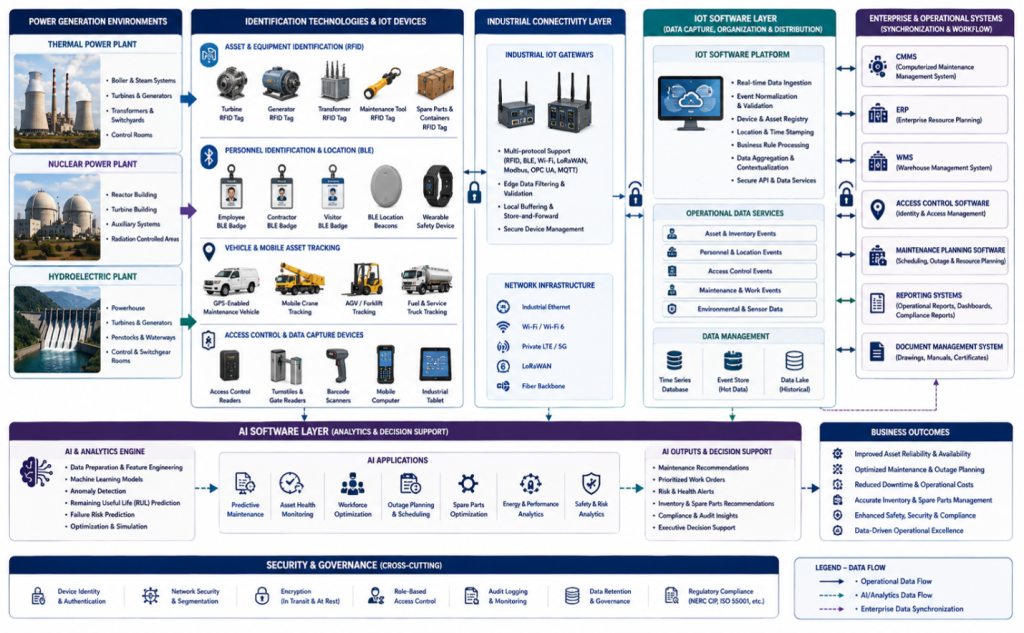
This block diagram illustrates how IoT software collects, validates, and distributes identification and location data from RFID, BLE, GPS, access control devices, and industrial gateways across thermal, nuclear, and hydroelectric power generation facilities. It also shows secure integration with enterprise software, the AI software layer for analytics and decision support, business outcomes, and cross-cutting security and governance to support reliable, compliant, and efficient plant operations.
Maintenance and Traceability IoT Software
Maintenance activities in power generation facilities involve coordinated work across operations, maintenance, engineering, procurement, warehouse management, and quality assurance teams. Every inspection, component replacement, overhaul, and work package generates operational records that must remain consistent throughout the asset lifecycle.
GenEnergy AI Maintenance and Traceability IoT Software organizes identification events from personnel, assets, replacement components, maintenance tools, and work activities into structured operational records. Rather than performing predictive analysis, the software ensures that maintenance information is complete, synchronized, and readily available to enterprise applications.
This structured data foundation supports scheduled maintenance, forced outages, capital improvement projects, and long-term asset lifecycle management across thermal, nuclear, and hydroelectric power generation facilities.
Work Order Tracking Software
Maintenance work orders coordinate thousands of activities throughout a generating station. Accurate work order documentation helps maintenance planners, supervisors, and engineering teams monitor maintenance progress while ensuring that personnel, equipment, and replacement components remain aligned with approved work packages.
Work Order Tracking Software supports:
- Digital work order assignment
- Association of personnel with maintenance activities
- Equipment identification linked to work orders
- Maintenance status updates
- Work package documentation
- Maintenance completion records
- Historical maintenance retrieval
- Coordination of multi-discipline maintenance teams
The software creates a consistent operational record that can be shared with CMMS, ERP, and engineering documentation systems, reducing duplicate data entry while improving record accuracy.
Component Traceability Software
Many components installed within turbines, generators, transformers, boilers, and auxiliary equipment require complete lifecycle documentation. Serial numbers, manufacturer information, installation dates, maintenance history, refurbishment activities, and replacement records all contribute to long-term equipment management.
Component Traceability Software supports:
- Serial number registration
- Asset-to-component association
- Installation documentation
- Removal and replacement records
- Maintenance history management
- Manufacturer and supplier documentation
- Warranty tracking
- Quality assurance documentation
These records simplify engineering reviews, support equipment lifecycle planning, and provide documented evidence during regulatory inspections or internal quality audits.
Maintenance Documentation Management
Maintenance organizations produce significant volumes of operational documentation, including inspection reports, maintenance procedures, permits, quality records, photographs, commissioning documents, and engineering approvals.
IoT software associates this documentation with identified assets, work orders, and maintenance activities, making information easier to retrieve throughout the equipment lifecycle.
Typical documentation includes:
- Inspection reports
- Maintenance procedures
- Equipment certifications
- Quality assurance records
- Installation photographs
- Commissioning documentation
- Service history
- Engineering change records
Centralized documentation improves consistency while reducing the time required to locate historical maintenance information.
Device-to-Software Communication Across Power Generation Facilities
Power generation facilities depend on numerous identification and communication technologies operating simultaneously across multiple operational areas. The IoT software layer serves as the coordination point that securely receives identification events, validates incoming information, standardizes operational records, and distributes them to authorized enterprise systems.
GenEnergy AI IoT software supports communication with a broad range of industrial identification technologies, including:
- RFID tags and fixed RFID readers
- BLE beacons and wearable identification devices
- GPS-enabled maintenance vehicles
- Barcode scanners
- Smart access control readers
- Mobile workforce devices
- Industrial gateways
- Existing enterprise software applications
Instead of functioning as a simple communication interface, the software performs several operational tasks before information reaches higher-level applications. These include:
- Device authentication
- Event validation
- Time synchronization
- Identification mapping
- Duplicate event filtering
- Operational record standardization
- Secure information routing
- Enterprise software synchronization
By maintaining consistent operational records, organizations improve data quality while reducing integration complexity across multiple departments.
IoT Software and AI and IoT Analytics Perform Different Roles
Although IoT software and AI and IoT solutions operate together, they serve distinct purposes within power generation operations.
The IoT software layer focuses on collecting, organizing, validating, and distributing operational information generated through industrial identification technologies. It provides trusted operational records that support maintenance management, workforce accountability, asset identification, inventory control, and compliance documentation.
The AI and IoT software layer builds upon this structured information by applying machine learning, Edge AI, computer vision where appropriate, and advanced analytical models to identify operational trends, recommend maintenance priorities, optimize workforce allocation, and improve engineering decision-making.
This separation provides several operational advantages:
Improved software scalability
Simplified software maintenance
Better data governance
Clear separation of operational responsibilities
Easier integration with existing enterprise systems
Higher-quality operational information for AI models
Organizations can modernize IoT infrastructure while introducing AI capabilities at their own pace without disrupting existing operational workflows.
Compatibility with Industrial Identification Technologies
Power generation organizations often operate a combination of legacy and modern identification systems across multiple facilities. GenEnergy AI IoT software is designed to integrate with commonly deployed industrial technologies without requiring complete infrastructure replacement.
Supported identification and communication technologies include:
- RFID passive identification systems
- Active RFID asset identification
- BLE personnel location systems
- GPS fleet and vehicle tracking
- Cellular communications for remote assets
- LoRaWAN communication networks
- Wi-Fi connectivity
- Industrial Ethernet
- OPC UA
- MQTT
- REST APIs
- Microsoft Active Directory integration
- Enterprise identity management systems
This broad compatibility allows utilities to preserve previous investments while expanding operational capabilities over time.
Applications Across Power Generation Operations
GenEnergy AI IoT Software supports operational activities throughout the lifecycle of electricity generation assets and maintenance operations.
Typical applications include:
- Workforce identification during scheduled outages
- Contractor credential administration
- Control room access management
- Restricted work area authorization
- Turbine maintenance coordination
- Generator overhaul documentation
- Boiler maintenance records
- Spare parts warehouse management
- Maintenance tool accountability
- Inventory movement documentation
- Work order coordination
- Component lifecycle documentation
- Regulatory compliance support
- Multi-site utility reporting
These applications provide a reliable operational data foundation that supports engineering, maintenance, warehouse, and security teams across thermal, nuclear, hydroelectric, and combined cycle generating facilities.
Industrial Experience Supporting Reliable IoT Software
GenEnergy AI was created within Aperture Venture Studio with support from GAO, leveraging more than two decades of industrial IoT experience gained through thousands of customer engagements and implementation projects. This experience has shaped software designed for the operational realities of critical infrastructure.
Continuous investment in research and development, rigorous quality assurance processes, and experienced engineering teams help ensure that GenEnergy AI software addresses the reliability, security, and operational requirements of modern power generation organizations.
Led by Ph.D. professionals from leading universities and supported by industry experts and strategic technology partners, the company combines academic research with practical implementation experience. GAO has supported Fortune 500 companies, leading research institutions, universities, and government agencies throughout the United States and Canada, contributing valuable knowledge that informs the design and evolution of GenEnergy AI software.
Build a Reliable Data Foundation for AI and IoT
Successful AI initiatives begin with trusted operational information. GenEnergy AI IoT Software establishes the reliable data foundation required to support workforce management, access control, asset identification, inventory management, maintenance documentation, and enterprise integration across power generation facilities.
Whether supporting thermal generating stations, nuclear facilities, hydroelectric plants, or multi-site utility operations, GenEnergy AI helps organizations organize operational information before it reaches advanced AI applications, enabling more accurate analytics, improved engineering decisions, and greater operational consistency.
Enterprise Data Flow from Industrial Identification to AI and IoT Software in Power Generation
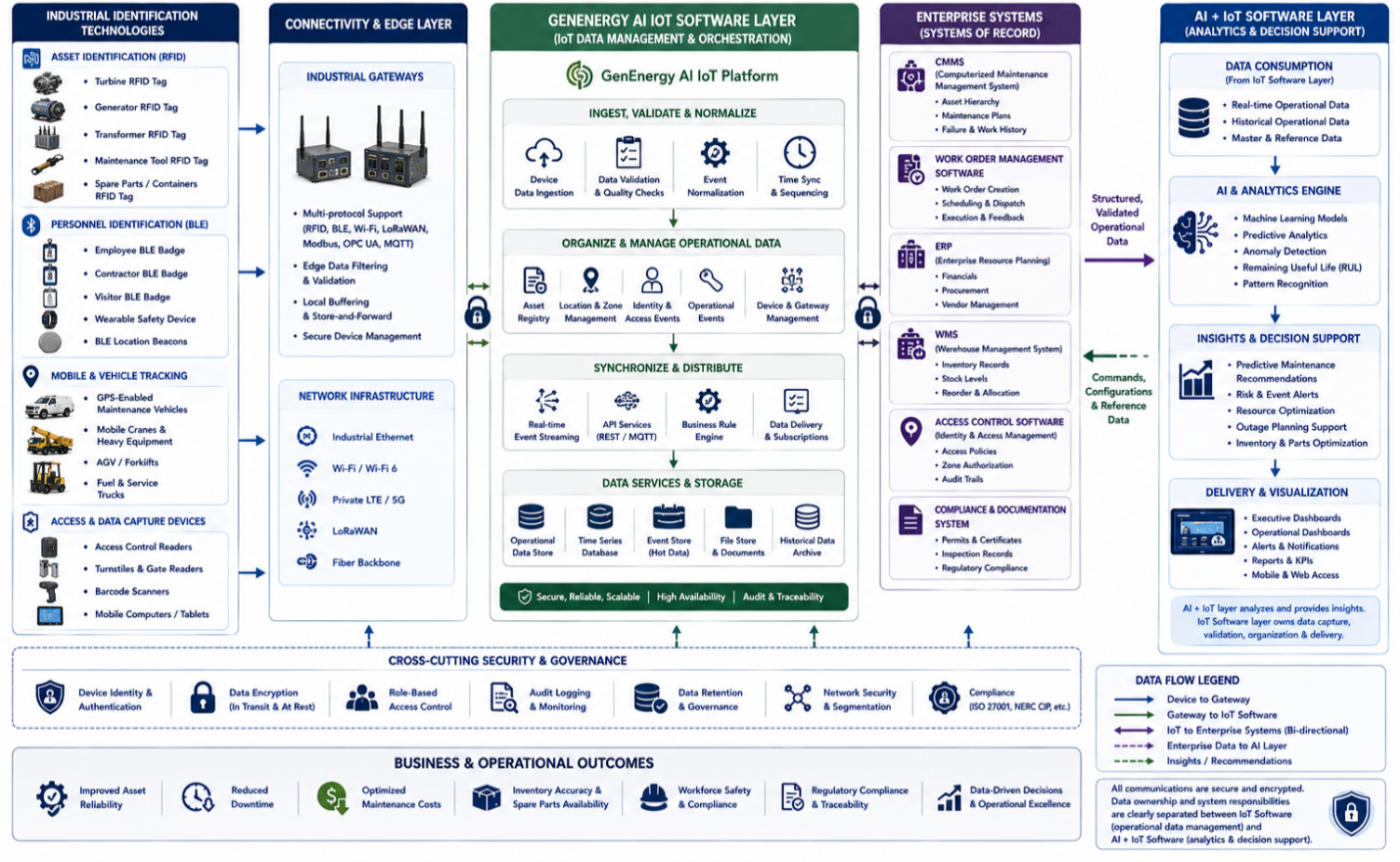
This enterprise data flow diagram illustrates how RFID, BLE, GPS, barcode, and access control technologies feed operational data into the GenEnergy AI IoT Software layer, where records are validated, organized, and synchronized with CMMS, ERP, warehouse, work order, and compliance systems. It also shows the AI and IoT software layer using structured operational data for analytics and decision support while maintaining a clear separation between operational data management and AI-driven analysis to improve asset reliability, maintenance efficiency, traceability, and regulatory compliance.