Edge System Integration for AI and IoT Power Generation Facilities
Connect AI and IoT software with SCADA, DCS, CMMS, ERP, RFID, BLE, LoRaWAN, GPS, and edge computing.
Edge System Integration for AI and IoT Power Generation Facilities
Connecting AI and IoT Software, Industrial Systems, and Enterprise Operations Across Modern Power Generation Facilities
Reliable AI and IoT deployments in power generation depend on far more than connected devices and wireless communications. Thermal power stations, hydroelectric generating facilities, nuclear generating stations, combined-cycle gas turbine plants, biomass generating facilities, and utility-scale renewable power sites require an integration layer that securely exchanges operational data between industrial control systems, enterprise software, location technologies, and AI applications.
GenEnergy AI provides edge system integration that connects identification and location technologies with operational software used throughout power generation facilities. Rather than operating as isolated applications, workforce location systems, access control software, RFID asset identification, BLE location services, inventory software, maintenance management applications, and enterprise reporting systems exchange information through secure middleware and standardized communication interfaces.
Artificial Intelligence of Things, commonly called AIoT or AI and IoT, combines artificial intelligence with connected industrial equipment, IoT devices, machine learning, Edge AI, computer vision, and industrial software. Within power generation facilities, AIoT enables operational software to process identification events from RFID, BLE, GPS, LoRaWAN, cellular IoT, and related technologies while supporting personnel accountability, asset visibility, spare parts management, outage coordination, and regulatory documentation.
Unlike traditional isolated industrial software deployments, GenEnergy AI focuses on interoperability between existing operational technologies and enterprise business systems without requiring major infrastructure replacement. The result is a secure software environment that improves information availability across turbine halls, switchyards, control rooms, warehouses, maintenance workshops, fuel handling areas, substations, cooling systems, and administrative facilities.
Applications Across Power Generation Facilities
Edge integration supports numerous operational workflows throughout power generation environments, including:
- Thermal power station maintenance coordination
- Nuclear plant controlled area access management
- Hydroelectric powerhouse workforce accountability
- Combined-cycle gas turbine outage management
- Generator rotor maintenance tracking
- Steam turbine overhaul documentation
- Transformer asset identification
- Spare parts warehouse visibility
- Critical valve inventory management
- Switchyard equipment identification
- Contractor access verification
- Visitor authorization management
- Mobile maintenance workforce coordination
- Fleet equipment location
- Emergency evacuation accountability
- Long-term asset lifecycle documentation
- Maintenance work package coordination
- Component traceability throughout overhaul cycles
These applications allow operational teams to maintain reliable identification, accountability, and documentation while reducing manual administrative processes.
Middleware and System Integration Layer Overview
Power generation facilities typically operate numerous independent software systems installed over many years. These frequently include Distributed Control Systems (DCS), Supervisory Control and Data Acquisition (SCADA), Computerized Maintenance Management Systems (CMMS), Enterprise Resource Planning (ERP), document management systems, access control software, warehouse management software, outage planning applications, and cybersecurity management solutions.
Without a properly designed integration layer, personnel information, asset locations, maintenance records, inventory updates, and operational events remain isolated within individual applications.
GenEnergy AI provides middleware that enables secure communication between these systems while preserving existing operational investments.
The middleware performs several important functions:
- Standardizes data formats between different software products
- Synchronizes personnel identification events
- Exchanges asset location records
- Coordinates inventory transactions
- Maintains maintenance work package references
- Supports role-based information exchange
- Eliminates duplicate data entry
- Maintains audit trails
- Supports secure authentication
- Simplifies future software expansion
Instead of replacing existing industrial software, the integration layer serves as the communication backbone that allows multiple software systems to exchange information using standardized interfaces.
This approach minimizes operational disruption while improving long-term maintainability.
Why Middleware Is Critical for Power Generation
Power generation facilities often remain operational for several decades.
During that lifespan, organizations continuously modernize individual software components without replacing the entire operational technology environment.
Typical modernization projects include:
- New RFID asset identification
- BLE workforce location systems
- Digital work order management
- Modern access control software
- Warehouse modernization
- Maintenance documentation software
- Contractor management systems
- Enterprise reporting solutions
Middleware enables these independently evolving software systems to communicate without requiring complete redevelopment of existing infrastructure.
This incremental modernization strategy significantly reduces implementation risk during plant upgrades.
Standardized Information Exchange
Modern AI and IoT software must exchange information consistently regardless of equipment manufacturer.
GenEnergy AI supports integration methods commonly used throughout industrial power generation, including:
- OPC UA
- Modbus TCP
- MQTT
- REST APIs
- HTTPS services
- SQL database synchronization
- XML interfaces
- JSON data exchange
- CSV batch synchronization
- Secure file transfer
These standardized communication methods simplify integration with both modern and legacy operational environments.
Data Normalization
Operational software frequently stores identical information using different naming conventions.
For example:
A maintenance management system may identify a steam turbine using one asset identifier while warehouse software references the same equipment using another inventory number.
The integration layer performs data normalization that associates multiple identifiers with the same physical asset.
This greatly reduces duplicate records while improving reporting consistency across maintenance, warehouse, engineering, and operational departments.
Secure Event Synchronization
Every identification event generated through RFID readers, BLE gateways, access control readers, GPS tracking devices, or LoRaWAN gateways can trigger multiple software updates simultaneously.
Examples include:
- Updating personnel attendance records
- Opening maintenance work packages
- Recording warehouse inventory movement
- Logging contractor arrival
- Updating access permissions
- Recording equipment transfers
- Synchronizing maintenance history
- Supporting regulatory documentation
Rather than maintaining multiple manual processes, synchronization distributes authorized information automatically to connected software systems.
AI and IoT System Integration for Power Generation Facilities
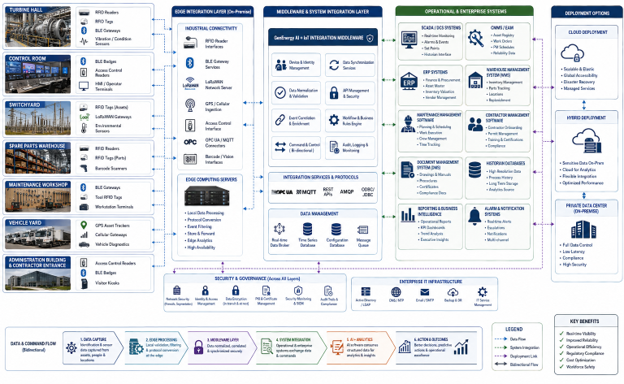
The diagram shows how RFID, BLE, GPS, LoRaWAN, and access control technologies connect through edge computing, middleware, and synchronization services to operational and enterprise systems. It illustrates secure information exchange among plant areas, SCADA and DCS environments, CMMS, ERP, warehouse management, maintenance software, and cloud or private data center deployments.
Interoperability with SCADA, DCS, CMMS, and Enterprise Systems
Power generation facilities depend upon multiple specialized software environments that perform different operational functions. Production control systems manage electricity generation, while maintenance software coordinates equipment servicing, enterprise software supports procurement and finance, and warehouse software maintains spare parts availability.
Successful AI and IoT deployments do not replace these established operational systems. Instead, they extend their capabilities by providing reliable identification, location awareness, and automated data exchange.
GenEnergy AI is designed to integrate with commonly deployed industrial software through secure middleware, enabling personnel identification events, RFID asset movements, BLE location updates, inventory transactions, and maintenance records to flow into existing operational workflows. This interoperability helps eliminate duplicate data entry, improves operational consistency, and supports lifecycle management across turbine halls, switchyards, maintenance workshops, warehouses, and administrative departments while preserving existing software investments.
Cloud SaaS Deployment Model
Cloud deployment is well suited for power generation organizations operating multiple generating stations, geographically distributed renewable energy sites, regional maintenance centers, and centralized engineering teams. Rather than maintaining independent software installations at every facility, organizations can securely manage AI and IoT identification and location data through a centrally administered cloud environment while allowing each plant to retain local operational control.
The cloud deployment model supports centralized visibility for personnel identification, access authorization, asset location, inventory records, maintenance documentation, and traceability reporting. Authorized users can securely access information from corporate offices, regional operations centers, maintenance planning departments, and approved remote engineering locations.
Typical cloud deployment capabilities include:
- Centralized user administration
- Multi-site asset identification
- Enterprise inventory synchronization
- Contractor credential management
- Central maintenance reporting
- Consolidated audit logging
- Disaster recovery support
- Automatic software updates
- High availability deployment
- Secure encrypted communications
Cloud deployment is particularly valuable for organizations managing thermal generating stations, hydroelectric facilities, renewable energy portfolios, and utility companies that require standardized operational procedures across multiple locations.
Benefits of Cloud Deployment
Cloud-based AI and IoT software simplifies administration while improving consistency across geographically dispersed facilities.
Operational advantages include:
- Central software management
- Reduced local server maintenance
- Faster software upgrades
- Simplified user provisioning
- Standardized security policies
- Enterprise-wide reporting
- Scalable storage capacity
- Improved business continuity
- Centralized backup management
- Simplified compliance reporting
Because power generation organizations frequently operate facilities across multiple jurisdictions, centralized software management also assists with maintaining consistent operational procedures while supporting regional regulatory requirements.
Multi-Site Operational Visibility
Power generation companies often maintain several generating assets that include:
- Coal-fired generating stations
- Combined-cycle gas turbine facilities
- Nuclear generating stations
- Hydroelectric power plants
- Solar generation facilities
- Wind farms
- Battery energy storage sites
- Corporate maintenance depots
- Central spare parts warehouses
Cloud deployment enables authorized personnel to review workforce accountability, asset movements, inventory availability, and maintenance progress across all participating facilities through a unified software environment.
Role-based access ensures that plant personnel only view information appropriate to their operational responsibilities.
On-Premises Server and Private Data Center Deployment
Many power generation operators require software to remain entirely within their own information technology infrastructure because of cybersecurity requirements, operational policies, or regulatory obligations. For these organizations, GenEnergy AI supports deployment within privately managed server environments and dedicated data centers.
An on-premises deployment allows organizations to maintain complete administrative control over software, databases, authentication services, backups, and network segmentation. The solution integrates with existing operational technology environments while remaining inside organizational security boundaries.
Common deployment locations include:
- Primary plant data centers
- Secondary disaster recovery facilities
- Utility corporate data centers
- Secure operational technology networks
- Dedicated engineering server rooms
- Isolated industrial network segments
This deployment approach is frequently selected for facilities where operational continuity, network isolation, and internal governance are primary considerations.
Advantages of Private Server Deployment
Organizations selecting private deployment typically prioritize:
- Local administrative control
- Internal cybersecurity governance
- Custom integration requirements
- Controlled software update schedules
- Dedicated database management
- Existing virtualization infrastructure
- Integration with internal identity management
- Reduced dependency on external connectivity
- Long-term operational stability
Private deployments also simplify integration with legacy industrial software that may not be suitable for cloud-based communication.
High Availability and Redundancy
Power generation operations require software systems that remain available throughout planned maintenance activities and unexpected infrastructure events.
Typical high availability measures include:
- Redundant application servers
- Database replication
- Failover clustering
- Virtual machine redundancy
- Backup power protection
- Storage redundancy
- Scheduled backup verification
- Disaster recovery testing
These measures help maintain continuous access to personnel identification records, asset locations, inventory databases, and maintenance documentation.
Edge Computing and Real-Time Synchronization
Edge computing plays an important role in AI and IoT deployments by allowing identification events to be processed close to operational activities before selected information is synchronized with enterprise software. This approach reduces latency, supports continued operation during temporary network interruptions, and minimizes unnecessary network traffic.
Within power generation facilities, edge computing systems commonly receive data from RFID readers, BLE gateways, access control readers, GPS tracking devices, LoRaWAN gateways, and cellular IoT devices. Local processing validates identification events, applies business rules, and securely exchanges approved information with enterprise software.
Typical edge processing functions include:
- Personnel identification validation
- Access authorization checks
- RFID asset movement verification
- Inventory transaction processing
- Local event filtering
- Temporary data buffering
- Secure message routing
- Local audit logging
- Time synchronization
- Automated retry after communication recovery
This distributed processing model improves operational resilience while maintaining consistent information across plant software systems.
Secure Synchronization Between Operational and Enterprise Systems
Synchronization ensures that information generated within operational areas remains consistent with enterprise business applications. For example, when maintenance personnel check out tagged equipment from a warehouse, the event can simultaneously update inventory records, maintenance work orders, and asset history without requiring duplicate manual entry.
Secure synchronization supports workflows such as:
- Workforce attendance updates
- Contractor check-in and check-out
- Asset transfers between departments
- Spare parts issuance
- Return-to-stock transactions
- Maintenance work package progress
- Equipment lifecycle documentation
- Compliance reporting
By maintaining consistent information across operational and enterprise systems, organizations reduce administrative effort while improving data quality and traceability.
Role of AI and IoT Within the Integration Layer
AI and IoT software complements existing industrial systems by interpreting identification and location events generated by connected devices. Rather than replacing SCADA, DCS, or CMMS software, AI and IoT enhances these environments with contextual awareness, automated event correlation, and operational decision support.
Typical AI and IoT capabilities within the integration layer include:
- Correlating personnel location with authorized work zones
- Verifying access permissions before operational activities
- Identifying asset movement anomalies
- Forecasting spare parts demand using inventory history
- Supporting outage planning through workforce and asset visibility
- Automating traceability records for maintenance activities
- Prioritizing event notifications based on operational context
These capabilities improve coordination across maintenance, operations, warehouse, engineering, and security teams while preserving the integrity of existing industrial control systems.
Deployment Selection Guidance for Power Generation IT Environments
Selecting the appropriate deployment model requires evaluating operational priorities, cybersecurity requirements, regulatory obligations, existing industrial software, and long-term maintenance strategies. Power generation facilities often operate for decades, making software deployment decisions critical to operational continuity and future scalability.
Each generating facility presents different technical requirements. A nuclear generating station may prioritize isolated operational technology networks and strict cybersecurity governance, while a utility managing numerous wind farms and solar facilities may benefit from centralized cloud administration. Combined-cycle gas turbine stations, hydroelectric facilities, and regional maintenance organizations frequently adopt deployment models that align with existing enterprise IT strategies and operational workflows.
Organizations should evaluate deployment decisions based on several technical considerations:
- Number of generating facilities
- Geographic distribution of operations
- Existing SCADA and DCS software
- CMMS and ERP integration requirements
- Internal cybersecurity policies
- Regulatory compliance obligations
- Network connectivity availability
- Disaster recovery objectives
- Internal IT support capabilities
- Software lifecycle management policies
Careful planning helps ensure that AI and IoT software complements existing operational environments without disrupting critical generating processes.
When Cloud Deployment Is Appropriate
Cloud deployment is generally appropriate when organizations require centralized administration across multiple facilities while maintaining standardized operational procedures. Large electric utilities, renewable energy operators, and independent power producers frequently benefit from centralized software management that supports geographically dispersed assets and personnel.
Cloud deployment is often selected when organizations require:
- Enterprise-wide personnel identification
- Multi-site workforce administration
- Centralized contractor management
- Shared inventory visibility
- Enterprise spare parts management
- Cross-facility asset identification
- Central software administration
- Remote engineering access
- Consolidated compliance reporting
- Rapid deployment of software enhancements
These capabilities help organizations maintain consistent operational practices while reducing administrative effort across multiple power generation facilities.
When Private Server Deployment Is Preferred
Private server deployment remains the preferred option for organizations requiring maximum administrative control over operational software and supporting infrastructure. Facilities operating within highly regulated environments often maintain dedicated operational technology networks with carefully controlled communication paths.
Private deployment is commonly selected when organizations require:
- Complete ownership of software infrastructure
- Internal database administration
- Controlled software release schedules
- Existing enterprise virtualization resources
- Integration with proprietary industrial software
- Network segmentation between business and operational environments
- Dedicated disaster recovery procedures
- Internal authentication services
- Long-term operational stability
- Facility-specific cybersecurity governance
This approach supports organizations that must maintain software entirely within their own controlled information technology environments.
Hybrid Deployment Strategies
Many power generation operators choose a hybrid deployment model that combines local operational processing with centralized enterprise management. This approach allows facilities to continue local operations during temporary communication interruptions while synchronizing approved information with centralized software once connectivity is restored.
Hybrid deployments are particularly valuable for organizations operating:
- Multiple generating stations
- Remote hydroelectric facilities
- Distributed solar generation sites
- Wind energy portfolios
- Regional maintenance centers
- Utility transmission support facilities
- Corporate engineering offices
- Centralized spare parts warehouses
Hybrid deployment balances operational resilience with enterprise visibility while supporting diverse operational environments across the power generation sector.
Applications Across Power Generation Facilities
AI and IoT software integration supports a wide range of operational activities throughout power generation environments by connecting identification technologies with existing enterprise software. The emphasis remains on accurate identification, secure access, asset location, inventory management, and maintenance traceability rather than replacing established industrial control systems.
Typical applications include:
- Workforce identification during planned outages
- Contractor credential verification before entering restricted operational areas
- Asset identification for turbines, generators, transformers, and mobile maintenance equipment
- Spare parts identification within maintenance warehouses
- Warehouse inventory reconciliation using RFID identification
- Control room access verification
- Nuclear protected area access management
- Hydroelectric equipment maintenance documentation
- Tool accountability during turbine overhauls
- Mobile asset identification across coal yards and fuel handling facilities
- Utility fleet equipment identification
- Maintenance work package traceability
- Equipment lifecycle documentation
- Enterprise audit record management
- Multi-site operational reporting
These applications support operational consistency while improving workforce accountability, equipment visibility, maintenance coordination, and inventory accuracy throughout power generation organizations.
Why GenEnergy AI
GenEnergy AI delivers AI and IoT software designed specifically for identification and location solutions within power generation environments. Rather than replacing existing SCADA, DCS, CMMS, ERP, or security software, our solutions integrate with established operational systems to improve personnel accountability, access management, asset identification, inventory control, and maintenance traceability.
Created within Aperture Venture Studio with support from GAO, GenEnergy AI builds upon more than two decades of practical IoT experience gained through thousands of customer deployments and implementation projects. This experience contributes to software designed for demanding industrial environments where reliability, operational continuity, and cybersecurity remain essential.
Our engineering teams invest extensively in research, software validation, and quality assurance while providing remote and onsite technical support throughout planning, deployment, integration, and long-term operation. Development is guided by Ph.D. professionals from leading universities together with experienced engineers and industry specialists focused on practical industrial applications.
GenEnergy AI solutions support organizations ranging from utilities and independent power producers to engineering firms, research organizations, Fortune 500 companies, universities, and government agencies throughout North America. Every deployment is planned with attention to interoperability, cybersecurity, operational resilience, and future scalability.
Conclusion
Power generation organizations continue to modernize their operational environments by integrating AI and IoT software with proven industrial systems. Secure identification technologies such as RFID, BLE, GPS, LoRaWAN, and cellular IoT devices provide reliable personnel, asset, and inventory visibility while preserving the operational integrity of existing control systems.
Successful deployments depend on selecting an appropriate software deployment model, establishing secure interoperability with enterprise applications, and maintaining synchronized operational records across maintenance, warehouse, engineering, and security functions. Whether implemented through cloud software, privately managed servers, or hybrid deployments, AI and IoT enables more consistent identification workflows, improved traceability, and greater operational transparency across thermal, hydroelectric, nuclear, renewable, and utility power generation facilities.
GenEnergy AI combines practical industrial expertise with proven AI and IoT software to help power generation organizations improve workforce accountability, secure facility access, asset identification, inventory accuracy, and maintenance traceability while supporting long-term operational reliability, cybersecurity, and regulatory compliance.
AI and IoT Identification Event Workflow for Power Generation
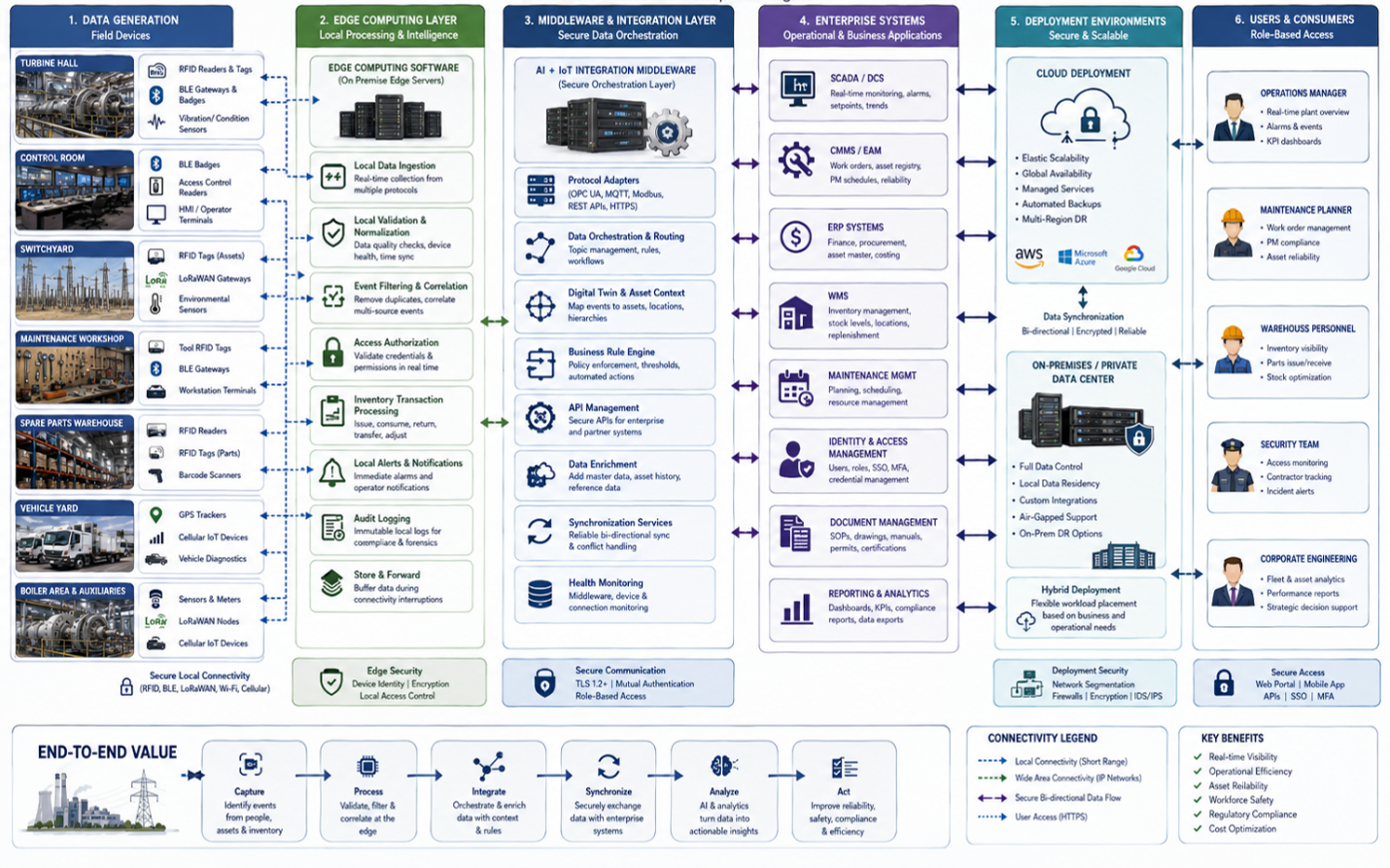
The workflow shows how identification events from power plant field devices move through edge processing, secure middleware, enterprise applications, and cloud or private data center environments. It connects operational users with systems such as SCADA, DCS, CMMS, ERP, warehouse management, and identity management, showing how validated data supports maintenance, access control, inventory, compliance, and operational decisions.