
AI and IoT Applications in Power Generation Facilities
AI and IoT Solutions Support Safe, Efficient, and Connected Power Generation Operations
Power generation facilities operate highly complex equipment while maintaining rigorous safety, regulatory, and operational requirements. Thermal generating stations, combined-cycle gas turbine plants, nuclear generating stations, hydroelectric facilities, wind farms, solar power stations, battery energy storage systems, and utility maintenance centers all depend on accurate identification, secure access management, asset visibility, and inventory control to support reliable electricity production.
Artificial Intelligence of Things, commonly referred to as AIoT or AI and IoT, combines artificial intelligence with connected industrial devices, identification technologies, machine learning, computer vision, Edge AI, and enterprise software.
Within power generation environments, AI and IoT primarily strengthens identification and location solutions by connecting RFID, BLE, LoRaWAN, GPS, cellular IoT, and access control technologies with existing operational systems such as SCADA, DCS, CMMS, ERP, warehouse management software, and physical security systems.
Rather than replacing established operational technology, AI and IoT complements existing software by providing accurate personnel identification, equipment location awareness, inventory visibility, maintenance traceability, and access verification across critical operational areas.
Applications span every stage of facility operation, including daily production, preventive maintenance, planned outages, contractor coordination, warehouse management, equipment overhauls, and regulatory reporting.
Applications Across Power Generation Facilities
Power generation organizations operate diverse facilities with varying operational requirements. Although thermal, hydroelectric, nuclear, renewable, and combined-cycle generating stations differ in production methods, they share common needs for workforce accountability, secure facility access, equipment identification, spare parts availability, and maintenance documentation.
AI and IoT software supports these activities through identification technologies that improve operational coordination without interfering with industrial control systems responsible for power generation.
Typical deployment environments include:
- Thermal power stations
- Combined-cycle gas turbine facilities
- Nuclear generating stations
- Hydroelectric power plants
- Pumped-storage hydro facilities
- Wind energy farms
- Substation maintenance facilities
- Solar photovoltaic generating facilities
- Battery energy storage sites
- Utility maintenance centers
- Regional engineering offices
- Spare parts distribution warehouses
- Fuel handling facilities
- Switchyards
Organizations benefit from improved operational visibility while preserving existing engineering processes and cybersecurity policies.
AI and IoT Identification and Location Technologies Across Power Generation Facilities
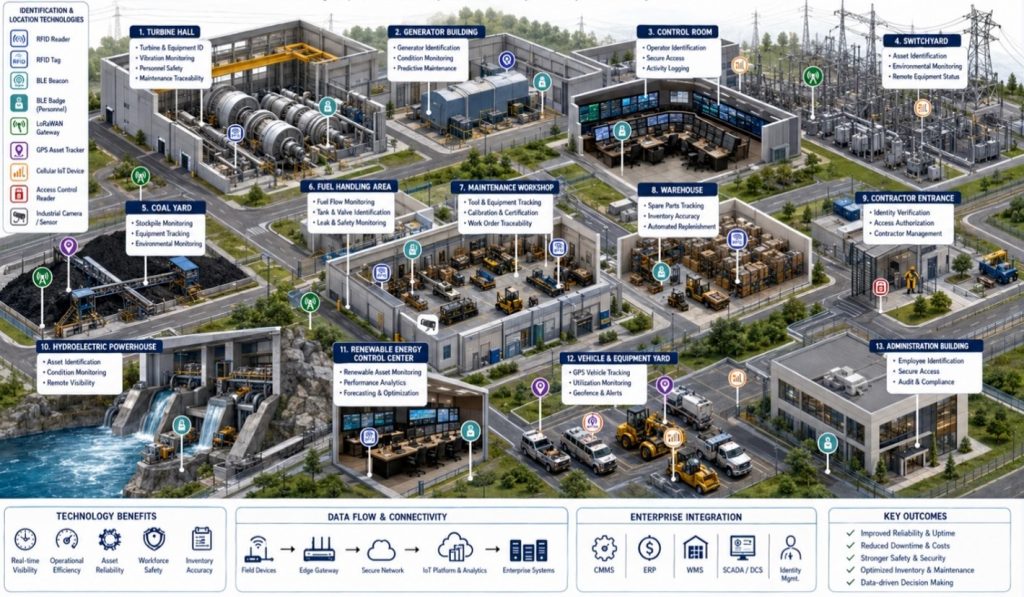
The isometric illustration maps AI and IoT identification and location technologies across turbine halls, generator buildings, control rooms, switchyards, coal yards, maintenance workshops, warehouses, hydroelectric facilities, renewable energy operations, contractor entrances, and vehicle yards. It shows how RFID, BLE, GPS, LoRaWAN, cellular, and access control technologies support personnel identification, asset tracking, secure access, inventory visibility, and maintenance traceability.
Turbine Hall and Generator Floor Applications
The turbine hall represents one of the most equipment-intensive areas within a power generation facility. Steam turbines, gas turbines, generators, lubrication systems, excitation equipment, auxiliary machinery, cranes, maintenance tooling, and mobile service equipment must all be managed throughout routine operations and scheduled maintenance activities.
AI and IoT supports identification and location workflows that improve coordination between maintenance personnel, operations teams, warehouse staff, and engineering departments. RFID tags attached to mobile assets, maintenance equipment, and specialized tools enable accurate identification as equipment moves between storage areas, workshops, and turbine halls.
BLE technologies assist with workforce location awareness inside large turbine buildings where satellite positioning is unavailable. Personnel carrying authorized identification badges can be associated with designated maintenance zones, improving accountability during planned outages and equipment inspections.
Typical applications include:
- Turbine maintenance tool identification
- Generator component identification
- Mobile equipment location
- Crane equipment accountability
- Contractor workforce identification
- Maintenance crew coordination
- Spare component verification
- Equipment return confirmation
- Maintenance documentation updates
- Temporary equipment allocation
AI and RFID software analyzes identification events generated throughout maintenance operations to reduce misplaced equipment, improve equipment utilization, and support maintenance scheduling.
Computer vision may complement identification technologies by verifying equipment handling procedures, while machine learning models analyze historical asset movement patterns to improve maintenance planning and equipment availability.
Control Room Access and Operational Security
Control rooms remain among the most secure operational environments within power generation facilities. Access is typically limited to authorized operators, engineers, supervisors, cybersecurity personnel, and approved maintenance specialists.
AI and IoT strengthens existing physical security procedures by integrating identification technologies with enterprise access control software. Personnel credentials can be validated using RFID identification cards, BLE-enabled credentials, NFC devices, biometric authentication where appropriate, and centralized identity management systems.
Authorized access events can be synchronized with enterprise software to support compliance reporting, workforce accountability, visitor management, and operational documentation.
Typical access management applications include:
- Multi-factor personnel identification
- Shift change verification
- Visitor authorization management
- Contractor access validation
- Restricted operational zone management
- Temporary maintenance access approval
- Emergency access logging
- Security audit documentation
- Identity lifecycle management
- Compliance reporting
GPS tracking devices support fleet visibility for authorized maintenance vehicles operating across large generating sites, while BLE technologies assist with personnel location awareness around maintenance work areas.
RFID identification simplifies movement of specialized maintenance equipment between workshops, fuel handling facilities, and storage areas, reducing equipment search times and improving maintenance efficiency.
Historical identification records also support maintenance investigations, contractor reporting, operational reviews, and regulatory documentation without introducing unnecessary manual recordkeeping.
Coal Yard and Fuel Handling Operations
Coal-fired generating stations and biomass facilities often operate expansive outdoor fuel handling areas where personnel, contractors, heavy equipment, and mobile maintenance assets move continuously throughout daily operations.
AI and IoT improves operational coordination by supporting identification and location of authorized personnel and mobile assets rather than relying solely on manual documentation.
Common identification workflows include:
- Contractor entry verification
- Heavy equipment identification
- Fuel transport vehicle authorization
- Mobile maintenance equipment tracking
- Shift workforce accountability
- Temporary work zone authorization
- Maintenance tool identification
- Vehicle access management
- Equipment staging coordination
- Operational audit recording
GPS tracking devices support fleet visibility for authorized maintenance vehicles operating across large generating sites, while BLE technologies assist with personnel location awareness around maintenance work areas.
RFID identification simplifies movement of specialized maintenance equipment between workshops, fuel handling facilities, and storage areas, reducing equipment search times and improving maintenance efficiency.
Historical identification records also support maintenance investigations, contractor reporting, operational reviews, and regulatory documentation without introducing unnecessary manual recordkeeping.
Nuclear Protected Area Access Applications
Nuclear generating stations maintain some of the industry’s most rigorous physical security and personnel accountability requirements. Access to protected operational areas requires strict authorization procedures supported by comprehensive documentation and identity verification.
AI and IoT complements established nuclear security procedures by improving personnel identification, credential validation, and controlled access management while integrating with existing security software.
Typical deployment areas include:
- Protected area entrances
- Equipment access points
- Maintenance workshops
- Reactor auxiliary buildings
- Engineering offices
- Temporary outage work zones
- Secure storage facilities
- Visitor processing centers
- Security checkpoints
- Contractor registration locations
RFID credentials, BLE identification devices, secure access readers, and enterprise identity management software work together to maintain accurate records of authorized personnel movement throughout controlled operational areas.
AI-assisted software correlates identification events with approved work schedules, maintenance authorizations, and contractor credentials, helping security teams verify that personnel access remains consistent with operational requirements.
Role-based permissions ensure that individuals only access locations appropriate to their assigned responsibilities while preserving detailed audit records that support regulatory compliance and long-term operational documentation.
Nuclear and Protected Area Access Applications
Nuclear generating stations require strict workforce accountability, credential verification, and controlled movement throughout protected operational areas. AI and IoT solutions support these objectives by combining secure identification technologies with software that validates personnel authorization before entry into designated work zones. Rather than replacing established physical security procedures, these systems strengthen compliance by automating identity verification, maintaining accurate access records, and reducing manual administrative effort.
Authorized employees, contractors, maintenance specialists, and inspection personnel can be identified through RFID credentials, BLE-enabled identification badges, biometric authentication devices, and secure access readers deployed throughout the facility. AIoT software correlates credential information, work assignments, access permissions, and maintenance schedules to determine whether entry requests comply with established operational procedures.
Typical deployment areas include:
- Protected access portals
- Reactor auxiliary buildings
- Turbine buildings
- Fuel handling facilities
- Radioactive material storage areas
- Maintenance workshops
- Engineering offices
- Emergency response coordination centers
- Equipment laydown areas
- Security command facilities
Operational capabilities commonly include:
- Multi-factor personnel identification
- Restricted area authorization validation
- Contractor credential verification
- Visitor escort management
- Workforce accountability reporting
- Electronic access history
- Maintenance authorization validation
- Temporary work permit verification
- Compliance audit documentation
- Emergency personnel accounting
Role-based permissions ensure operators, maintenance teams, radiation protection personnel, engineering staff, contractors, and security administrators receive access only to approved operational areas while maintaining complete audit records for regulatory review.
Power generation organizations operating nuclear facilities often integrate these identification workflows with work authorization procedures, maintenance planning, outage scheduling, and security management systems to reduce manual recordkeeping and improve operational consistency.
AI and IoT Personnel Access Workflow for Nuclear Power Generation
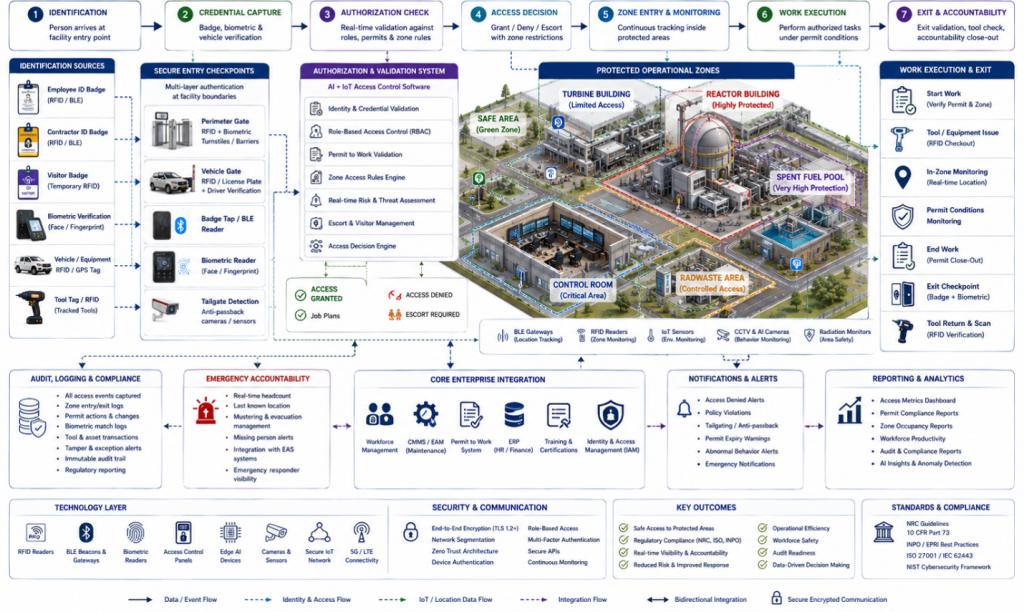
The workflow illustrates how employee and contractor identification moves through secure entry checkpoints, authorization validation, protected operational zones, maintenance work permits, and audit logging. It shows how AI and IoT access records support workforce accountability and integration with enterprise systems across nuclear power generation facilities.
Outage and Overhaul Maintenance Applications
Planned outages represent some of the most resource-intensive activities within power generation facilities. Hundreds or thousands of contractors, temporary personnel, maintenance specialists, inspection teams, and equipment suppliers may work simultaneously across multiple generating units. Coordinating personnel movement, access authorization, asset availability, maintenance documentation, and spare parts distribution becomes increasingly complex as outage activities expand.
AI and IoT identification and location solutions improve outage execution by providing real-time visibility into workforce deployment, equipment allocation, maintenance progress, and inventory utilization. RFID-tagged tools, BLE-enabled maintenance equipment, access credentials, and digital work authorization records reduce manual coordination while supporting operational safety and regulatory compliance.
Typical outage activities benefiting from AIoT include:
- Turbine overhauls
- Generator inspections
- Boiler maintenance
- Heat recovery steam generator servicing
- Cooling water system maintenance
- Transformer replacement
- Switchyard maintenance
- Valve inspections
- Pump refurbishment
- Electrical testing and commissioning
Operational capabilities include:
- Contractor workforce identification
- Tool checkout verification
- Equipment movement tracking
- Maintenance work package validation
- Digital work authorization support
- Access control for active maintenance zones
- Component traceability
- Spare parts issuance
- Mobile maintenance documentation
- Outage progress reporting
Maintenance supervisors benefit from centralized visibility into personnel assignments, active work packages, completed maintenance activities, and equipment availability. Warehouse teams can coordinate the release and return of maintenance tools while ensuring serialized assets remain associated with the correct maintenance task throughout the outage lifecycle.
Traceability also improves post-maintenance documentation by linking personnel identification, installed replacement components, inspection activities, maintenance approvals, and equipment histories within a unified software environment.
Organizations managing large-scale outage programs across multiple generating stations can further standardize maintenance reporting, workforce accountability, and spare parts utilization through centrally administered AI and IoT software while allowing individual facilities to maintain local operational control.
Spare Parts Warehouse and Inventory Applications
Reliable spare parts management remains essential for maintaining turbine availability, reducing forced outages, and supporting long-term equipment reliability. Critical replacement components such as bearings, valves, seals, electrical assemblies, control modules, motors, pumps, switchgear components, transformers, instrumentation devices, and maintenance tooling must remain accurately identified and readily accessible throughout their operational lifecycle.
AI and IoT inventory management combines RFID identification, BLE asset location, warehouse software, and machine learning algorithms to improve inventory visibility across central warehouses, maintenance depots, and satellite storage facilities.
Common warehouse deployment areas include:
- Central MRO warehouses
- Turbine maintenance storage
- Electrical equipment rooms
- Emergency spare parts facilities
- Contractor laydown areas
- Mobile maintenance trailers
- Long-term preservation storage
- Hazardous materials storage
- Calibration equipment rooms
- Satellite maintenance warehouses
Typical inventory management capabilities include:
- Automated inventory identification
- Warehouse location management
- Serialized component tracking
- Asset checkout verification
- Return-to-stock validation
- Inventory reconciliation
- Shelf location optimization
- Maintenance reservation management
- Expiration monitoring
- Inventory audit support
RFID readers positioned at warehouse entry and exit locations automatically record asset movements, while BLE beacons assist maintenance personnel in locating stored equipment across large warehouse facilities. AI-driven software analyzes historical usage patterns, maintenance schedules, seasonal demand, and outage planning information to forecast spare parts requirements and reduce unnecessary inventory accumulation.
Inventory traceability also supports warranty management, lifecycle documentation, and regulatory recordkeeping by maintaining complete historical records for every tracked component from receipt through installation, refurbishment, retirement, or disposal.
Organizations operating multiple power generation facilities benefit from centralized inventory visibility, enabling spare parts transfers between generating stations while minimizing duplicate inventory investments and improving equipment availability.
AI and IoT Spare Parts Warehouse for Power Generation
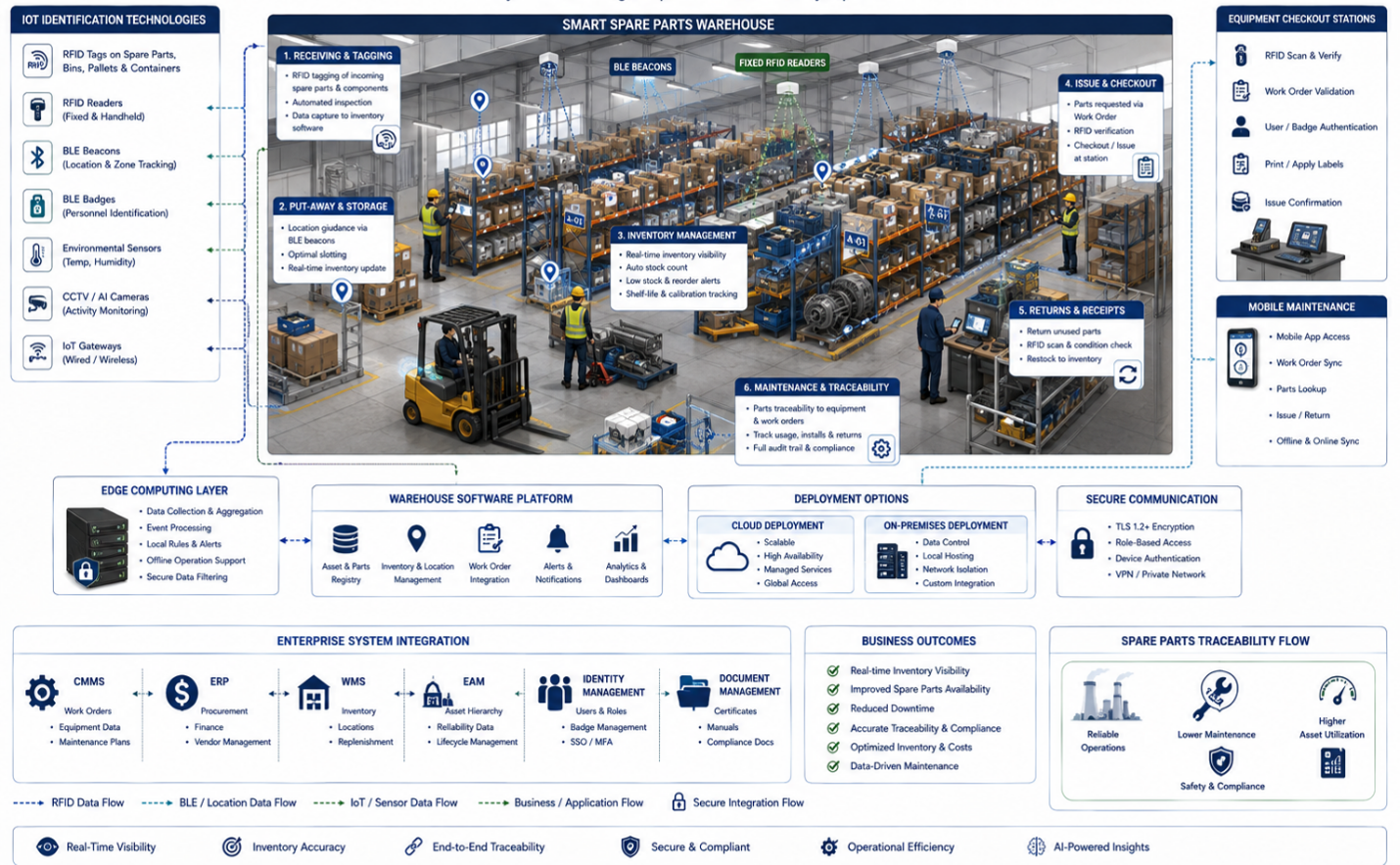
The visual shows how RFID-tagged spare parts, BLE identification, warehouse software, edge computing, and equipment checkout processes support inventory visibility and maintenance traceability. It also illustrates integration with CMMS, ERP, WMS, identity management, and document systems across power generation operations.
Brief Applications Across Power Generation Facilities
AI and IoT identification and location solutions support operational improvements across diverse power generation environments while complementing established operational technology, maintenance procedures, and security programs.
Representative applications include:
- Workforce accountability during planned outages
- Contractor credential validation
- Restricted area access management
- RFID-based maintenance tool identification
- BLE-enabled equipment location
- Warehouse inventory optimization
- Spare parts lifecycle documentation
- Turbine maintenance coordination
- Generator component traceability
- Mobile workforce identification
- Fleet asset visibility
- Visitor access management
- Emergency evacuation accountability
- Maintenance work order validation
- Enterprise audit reporting
GenEnergy AI develops these solutions using practical implementation experience gained through GAO, combining two decades of IoT expertise with extensive deployment knowledge across complex industrial environments. Supported by substantial research and development, rigorous quality assurance processes, and remote as well as onsite technical services, our solutions are designed to integrate with existing operational procedures rather than disrupt them. This experience has been strengthened through projects supporting Fortune 500 organizations, research institutions, universities, and government agencies across North America while remaining focused on secure, standards-based identification and location technologies for power generation operations.