
Resources for AI and IoT Power Generation Deployments
Technical Documentation Supporting Evaluation, Integration, Deployment, and Long-Term Operation
Power generation organizations require accurate technical information before implementing AI and IoT solutions across generating stations, turbine halls, control rooms, maintenance workshops, warehouses, substations, and corporate engineering environments. The Resources section provides technical documentation intended for plant managers, operations engineers, maintenance supervisors, OT and IT teams, cybersecurity specialists, procurement professionals, system integrators, and project engineers evaluating identification and location technologies.
The documentation focuses on practical implementation guidance, interoperability, deployment planning, operational best practices, and long-term lifecycle management rather than product marketing. Materials are written to support organizations operating thermal generating stations, combined-cycle power plants, hydroelectric facilities, nuclear generating stations, renewable energy sites, battery energy storage systems, and utility maintenance organizations.
Technical Documentation
Technical documentation explains how AI and IoT software, RFID systems, BLE technologies, GPS tracking devices, access control equipment, and enterprise software integrate within power generation facilities while maintaining compatibility with existing operational technology environments.
Documentation categories include:
- Software deployment guides
- RFID implementation manuals
- BLE deployment recommendations
- Access control integration references
- Asset tracking implementation guides
- Workforce identification documentation
- Inventory management configuration guides
- Maintenance traceability documentation
- Edge computing deployment references
- Cloud deployment guidance
- Private server deployment documentation
- Disaster recovery planning references
- System administration manuals
- Software upgrade procedures
- Cybersecurity implementation recommendations
Each document emphasizes operational reliability, regulatory compliance, secure communications, and practical deployment considerations specific to power generation environments.
Organizations evaluating GenEnergy AI solutions benefit from documentation developed through extensive implementation experience gained with support from GAO. This experience reflects thousands of IoT deployments across industrial environments and is continuously refined through engineering research, quality assurance processes, and customer implementation feedback.
Frequently Asked Questions
Power generation facilities employ operators, maintenance technicians, reliability engineers, electrical specialists, mechanical contractors, instrumentation personnel, outage teams, inspectors, and security personnel who frequently move between operational areas throughout each shift.
Maintaining awareness of workforce location and authorization is essential for both operational efficiency and personnel safety, particularly during major outages, emergency response situations, or maintenance shutdowns.
AI and IoT software continuously analyzes workforce movement using RFID credentials, BLE location technologies, access authorization records, work assignments, and operational schedules to provide a comprehensive understanding of workforce activity.
Which power generation facilities are supported?
The software supports identification and location applications across:
- Coal-fired generating stations
- Combined-cycle gas turbine plants
- Simple-cycle gas turbine facilities
- Nuclear generating stations
- Hydroelectric generating stations
- Solar generation facilities
- Wind energy sites
- Battery energy storage systems
- Utility maintenance centers
- Spare parts warehouses
- Corporate engineering offices
Which identification technologies are supported?
The solution supports multiple identification and location technologies depending on operational requirements, including:
- UHF RFID
- HF RFID
- NFC
- BLE
- GPS asset tracking
- Cellular IoT devices
- LoRaWAN
- Wi-Fi
- Access control credentials
- Biometric authentication devices
Organizations may deploy one technology or combine multiple technologies within a unified software environment.
Can the software integrate with existing industrial systems?
Yes. The software is designed to exchange operational information with commonly deployed industrial environments, including:
- SCADA systems
- Distributed Control Systems (DCS)
- Computerized Maintenance Management Systems (CMMS)
- Enterprise Resource Planning (ERP)
- Warehouse Management Systems (WMS)
- Active Directory
- Identity management services
- Enterprise reporting software
- Maintenance scheduling applications
Integration approaches are selected according to operational requirements, cybersecurity policies, and existing IT infrastructure.
How does AI improve operational workflows?
AI analyzes identification events, location information, historical maintenance records, inventory transactions, and operational workflows to automate routine processes and improve decision support.
Examples include:
- Workforce authorization validation
- Asset movement verification
- Inventory demand forecasting
- Maintenance scheduling assistance
- Traceability automation
- Operational event prioritization
- Compliance reporting support
The software complements existing operational systems rather than replacing industrial control software responsible for power generation processes.
Is cloud deployment required?
No. Organizations may deploy the software through:
- Cloud-hosted environments
- Private cloud environments
- On-premises servers
- Utility data centers
- Hybrid deployment models
Deployment selection depends upon operational policies, cybersecurity requirements, corporate governance, and regulatory obligations.
Power Generation AI and IoT Deployment Decision Tree
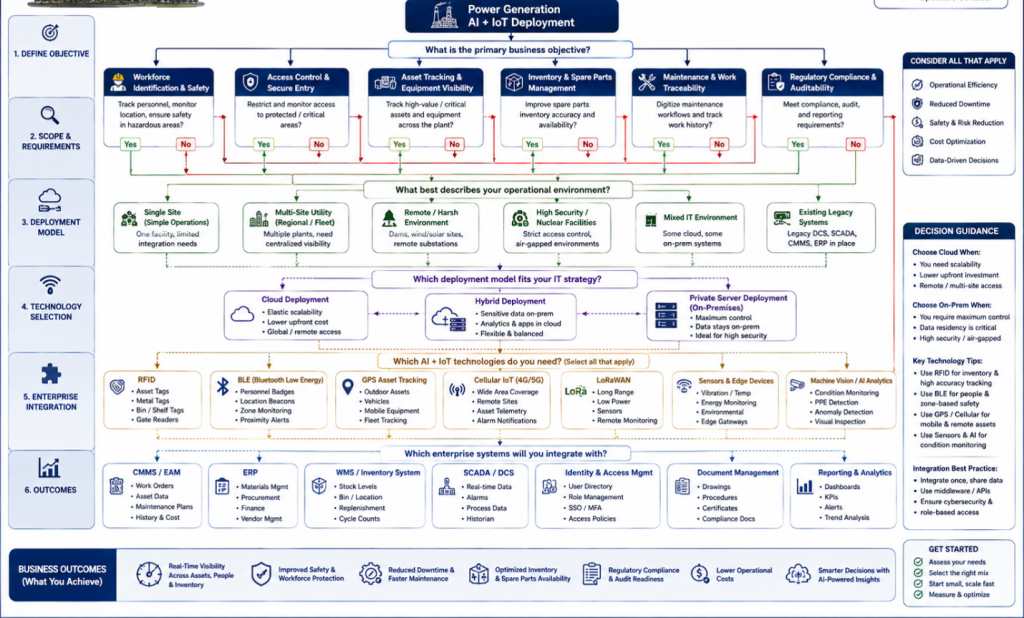
The decision tree guides power generation teams from operational objectives and site conditions through deployment model selection, RFID, BLE, GPS, cellular, and enterprise software integration. It helps engineering, operations, safety, and IT teams align technology choices with workforce identification, access control, asset tracking, inventory, maintenance traceability, and compliance requirements.
Integration Guides
Successful deployment requires careful coordination between operational technology, enterprise software, cybersecurity policies, and facility operating procedures. The integration guides provide detailed implementation recommendations for connecting AI and IoT solutions with existing software while minimizing operational disruption.
Available integration guidance includes:
- SCADA integration workflows
- DCS interoperability guidance
- CMMS synchronization
- ERP integration procedures
- Warehouse management integration
- Identity management integration
- Access control synchronization
- RFID deployment planning
- BLE coverage planning
- GPS fleet integration
- Cloud deployment planning
- Private server deployment planning
- Edge computing configuration
- Disaster recovery implementation
Each guide discusses data exchange methods, authentication practices, software configuration, redundancy planning, cybersecurity considerations, and validation procedures appropriate for industrial environments.
Engineering teams can use these documents during feasibility studies, procurement planning, pilot deployments, and production implementation.
Technical Specifications
The technical specifications provide engineering-level information supporting procurement, deployment planning, interoperability assessment, and lifecycle management.
Typical specification categories include:
- Supported operating systems
- Database compatibility
- Virtualization support
- Browser compatibility
- Mobile device support
- RFID reader compatibility
- BLE gateway compatibility
- Software scalability considerations
- GPS device compatibility
- Cellular communication support
- Authentication methods
- Encryption standards
- Backup requirements
- Network bandwidth recommendations
- High availability options
- Storage capacity guidance
Documentation is regularly reviewed by engineering teams led by Ph.D. professionals and supported by ongoing research and development activities to reflect evolving operational requirements within power generation facilities.
Deployment Planning References
Implementation planning begins long before software installation. Technical planning documents help organizations evaluate operational objectives, cybersecurity requirements, infrastructure readiness, and deployment priorities before beginning implementation.
Planning references include:
- Site readiness assessments
- Infrastructure evaluation checklists
- Network planning guidance
- RFID deployment planning
- BLE coverage recommendations
- Access control assessment worksheets
- Asset identification planning
- Inventory classification templates
- User role planning
- Cybersecurity preparation
- Data migration planning
- Acceptance testing procedures
- Operator training recommendations
- Maintenance planning references
- Long-term support planning
These resources assist engineering teams in reducing implementation risk while supporting predictable deployment schedules and long-term operational sustainability.
Why GenEnergy AI
GenEnergy AI was created within Aperture Venture Studio with support from GAO to deliver enterprise AI and IoT solutions tailored for complex industrial operations, including power generation. The company builds upon more than two decades of IoT experience gained through thousands of successful projects and extensive collaboration with industrial organizations.
Continuous investment in research and development, comprehensive quality assurance processes, and experienced engineering support enables GenEnergy AI to deliver technically sound software that integrates with established operational procedures. Remote and onsite implementation services help organizations address deployment planning, integration, commissioning, training, and long-term operational support.
Engineering leadership includes Ph.D. professionals from leading universities working alongside specialists in industrial automation, AI, RFID, BLE, cybersecurity, enterprise software, and operational technology. This multidisciplinary expertise supports practical solutions aligned with the reliability, security, and compliance expectations of modern power generation organizations.
Conclusion
Reliable power generation depends on accurate workforce accountability, secure access management, dependable asset identification, efficient inventory control, and complete maintenance traceability. AI and IoT solutions strengthen these operational processes by connecting identification technologies with enterprise software while preserving existing operational technology investments.
GenEnergy AI provides software designed specifically for power generation organizations seeking secure identification and location solutions that integrate with established operational workflows. Whether deployed within cloud environments, private data centers, or hybrid infrastructures, the software supports operational visibility, regulatory compliance, maintenance coordination, and enterprise reporting while helping engineering, operations, warehouse, maintenance, and security teams make informed decisions based on trusted operational information.
AI and IoT Identification and Location Solution Overview for Power Generation
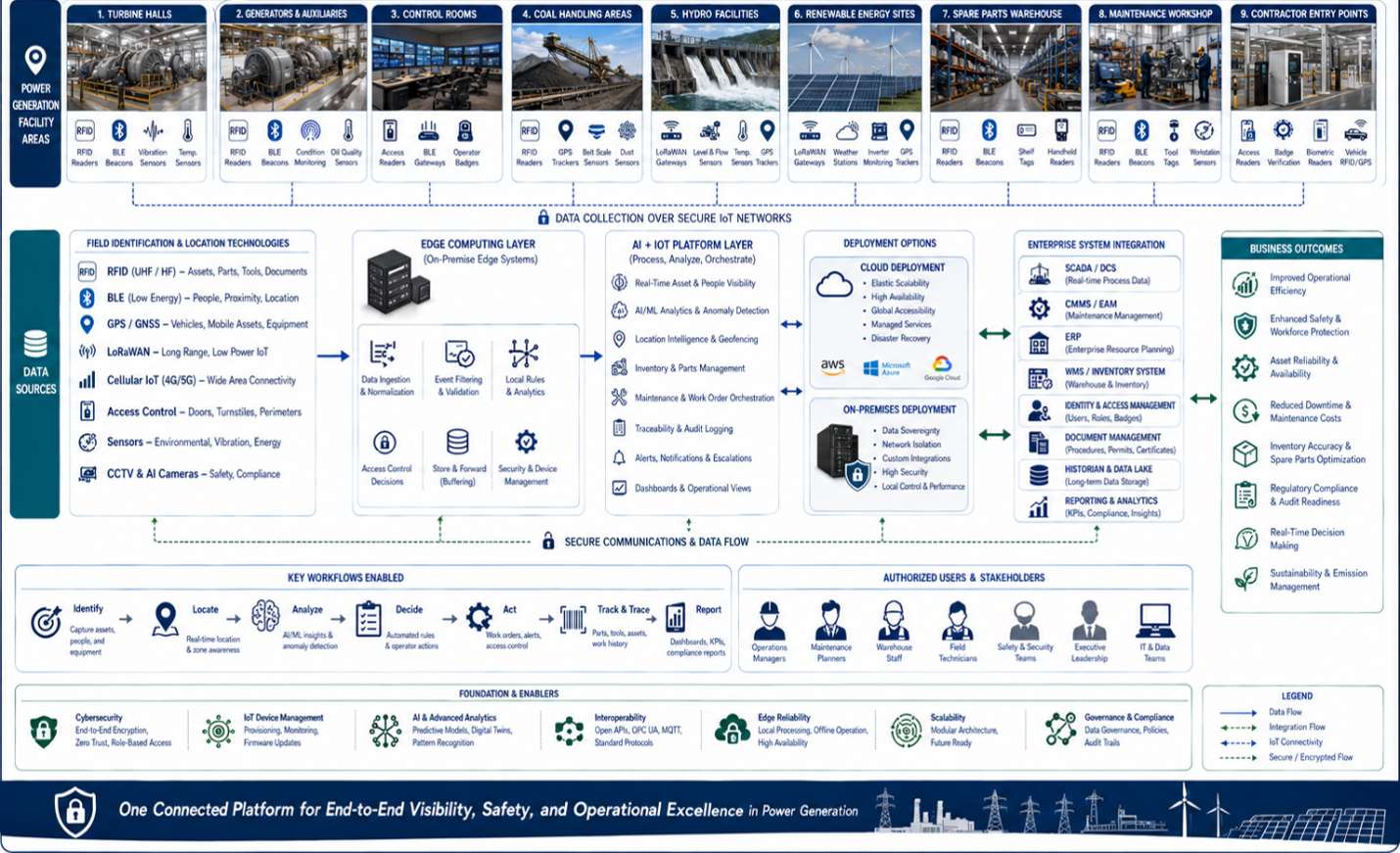
The diagram presents an end-to-end AI and IoT solution for power generation, connecting turbine halls, control rooms, coal handling areas, hydro facilities, renewable sites, warehouses, workshops, and contractor entrances. It shows how RFID, BLE, GPS, access control, edge computing, cloud or on-premises software, and enterprise integrations support workforce identification, asset tracking, inventory management, maintenance traceability, and operational reporting.