AI Functions for AIoT-Enabled Power Plant Operations
Transforming Operational Data into Actionable Decisions for Power Generation Facilities
AI and IoT Software for Power Generation Operations
Modern power generation facilities operate within an environment where reliability, availability, workforce safety, equipment lifecycle management, and regulatory compliance must be maintained simultaneously. Thermal generating stations, nuclear power plants, hydroelectric facilities, combined cycle gas turbine plants, biomass facilities, and cogeneration plants all depend upon accurate operational information to support safe electricity production and efficient maintenance planning.
GenEnergy AI develops AI and IoT software specifically for power generation organizations seeking to improve workforce accountability, facility access management, critical asset visibility, maintenance planning, spare parts availability, and operational traceability. Rather than functioning as another source of raw operational data, the software applies artificial intelligence, machine learning, Edge AI, computer vision, industrial identification technologies, and enterprise analytics to convert operational events into practical recommendations for engineers, maintenance supervisors, plant managers, warehouse personnel, and executive decision-makers.
Artificial Intelligence of Things, commonly called AIoT or AI and IoT, combines artificial intelligence with connected industrial devices, RFID identification, BLE location technologies, industrial communication systems, machine learning, computer vision, and industrial software. Within power generation facilities, AIoT enables software to recognise operational patterns, identify exceptions, predict maintenance priorities, optimise resource utilisation, and improve operational decision-making across the entire facility.
Unlike industrial connectivity software that primarily transfers operational information between systems, AI and IoT software analyses operational events, identifies relationships, detects anomalies, recommends actions, and supports faster operational decisions. This distinction allows power generation organisations to move beyond data collection toward measurable operational improvements.
AI and IoT Software Supporting the Entire Power Generation Lifecycle
Every generating station manages thousands of interconnected operational activities each day. Employees move between secure work areas, contractors perform scheduled maintenance, maintenance teams locate replacement components, warehouse personnel allocate spare parts, engineering groups analyze equipment history, and plant operators coordinate production schedules.
Managing these activities efficiently requires software capable of understanding operational relationships rather than simply storing information.
GenEnergy AI applies AI and IoT across the complete operational lifecycle by combining identification technologies with advanced analytics. Information collected from RFID credentials, BLE location systems, GPS-enabled maintenance assets, access control records, computerized maintenance management systems (CMMS), enterprise resource planning (ERP) software, warehouse management systems (WMS), outage management software, and operational databases is analyzed to provide actionable recommendations.
Typical operational objectives include:
- Improving workforce accountability across multiple operating units
- Supporting secure access to restricted operational areas
- Increasing visibility of critical generation assets
- Optimizing maintenance planning and execution
- Improving spare parts availability
- Strengthening outage coordination
- Enhancing equipment lifecycle documentation
- Supporting regulatory reporting requirements
- Improving enterprise-wide operational consistency
This approach allows engineering and maintenance organizations to make informed operational decisions using historical records, real-time identification data, and AI-assisted recommendations rather than relying exclusively on manual reporting.
Personnel Safety and Workforce Movement Analytics
Power generation facilities employ operators, maintenance technicians, reliability engineers, electrical specialists, mechanical contractors, instrumentation personnel, outage teams, inspectors, and security personnel who frequently move between operational areas throughout each shift.
Maintaining awareness of workforce location and authorization is essential for both operational efficiency and personnel safety, particularly during major outages, emergency response situations, or maintenance shutdowns.
AI and IoT software continuously analyzes workforce movement using RFID credentials, BLE location technologies, access authorization records, work assignments, and operational schedules to provide a comprehensive understanding of workforce activity.
Workforce Presence Analytics
Workforce presence analytics helps organizations understand where personnel are located throughout the facility while ensuring operational activities remain aligned with approved work assignments.
AI-assisted software evaluates identification events to support:
- Workforce attendance verification
- Shift transition management
- Department-level workforce allocation
- Authorized personnel verification
- Maintenance crew accountability
- Work area occupancy analysis
- Operational staffing visibility
- Resource planning for scheduled maintenance
Supervisors can use this information to allocate personnel more effectively while maintaining awareness of staffing levels across turbine halls, boiler buildings, switchyards, maintenance workshops, warehouses, and control rooms.
Contractor Movement Analytics
Major maintenance projects often involve hundreds of contractors working alongside permanent plant personnel. Coordinating contractor activities while maintaining compliance with plant operating procedures presents significant administrative challenges.
AI and IoT software helps organizations evaluate contractor movement by correlating identification records with work permits, approved work locations, scheduled maintenance activities, and authorized access privileges.
Operational benefits include:
- Improved contractor accountability
- Verification of approved work locations
- Better coordination during outage maintenance
- Improved contractor scheduling visibility
- Reduced administrative reporting effort
- Enhanced workforce documentation
These capabilities become especially valuable during turbine overhauls, boiler maintenance, generator refurbishment, electrical upgrades, and capital improvement projects.
Confined Space Activity Management
Maintenance activities frequently require authorized entry into confined spaces associated with boilers, condensers, tanks, ductwork, cooling systems, and other enclosed operational areas.
AI-assisted software helps maintenance supervisors verify personnel authorization, document confined space entry and exit events, and maintain accurate operational records supporting established safety procedures.
Although confined space management remains governed by approved operational processes, AI and IoT software improves documentation accuracy and workforce accountability throughout these activities.
Emergency Workforce Accountability
During operational incidents or emergency response events, facility managers require immediate awareness of personnel assigned to affected operational areas.
AI and IoT software assists emergency response teams by rapidly identifying:
- Personnel currently within operational zones
- Workforce assigned to maintenance activities
- Contractor accountability status
- Muster point attendance
- Personnel evacuation progress
- Occupied operational locations
These capabilities improve emergency coordination while reducing manual reconciliation efforts during time-sensitive situations.
Facility and Zone Access Analytics
Power generation facilities contain numerous operational areas requiring controlled access based on employee qualifications, maintenance assignments, operational status, and regulatory requirements.
Examples include:
- Main control rooms
- Turbine halls
- Generator buildings
- Boiler operating areas
- High-voltage switchgear rooms
- Electrical substations
- Fuel handling facilities
- Nuclear controlled areas
- Chemical storage buildings
- Maintenance workshops
- Data centers
- Security control rooms
AI and IoT software continuously evaluates identification events to help organizations maintain secure facility operations while reducing administrative complexity.
Restricted Area Access Analytics
Rather than relying solely on traditional access control logs, AI-assisted software evaluates access patterns, authorization status, work schedules, and historical movement records to identify unusual operational events that may require supervisory review.
Examples include:
- Access attempts outside scheduled work hours
- Repeated authorization failures
- Unexpected movement between restricted work zones
- Access inconsistencies with assigned work orders
- Unauthorized contractor movement
- Access activity requiring compliance review
These analytical capabilities help security and operations teams maintain stronger operational governance while supporting established security policies.
Control Room Access Analytics
Control rooms represent one of the most operationally sensitive areas within a generating facility. Access is typically restricted to authorized operators, engineering personnel, and approved maintenance staff.
AI and IoT software supports control room operations by:
- Verifying personnel authorization
- Recording entry and exit activities
- Associating access events with work schedules
- Supporting audit documentation
- Maintaining historical operational records
- Assisting compliance reporting
Historical analysis also helps organizations understand long-term access trends, workforce utilization, and operational patterns without increasing administrative workloads.
AI and IoT Operational Decision Workflow for Power Generation Facilities
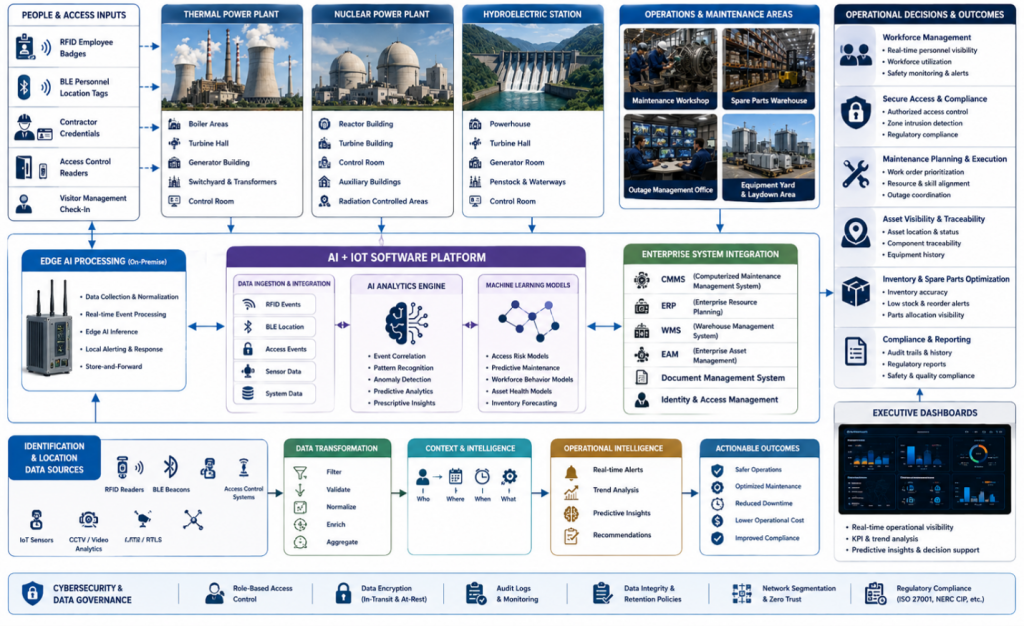
This diagram illustrates how AI and IoT software converts identification and location data from personnel, assets, and secured facilities into operational workflows across thermal, nuclear, and hydroelectric power plants. It shows the integration of Edge AI processing, RFID, BLE, access control, CMMS, ERP, WMS, and executive dashboards to support workforce management, maintenance planning, asset traceability, inventory optimization, compliance reporting, and real-time operational decision-making.
Critical Asset Performance Analytics for Power Generation Facilities
Reliable power generation depends on the continuous availability of turbines, generators, boilers, transformers, condensers, pumps, motors, excitation systems, switchgear, cooling systems, and auxiliary equipment. Every maintenance decision influences plant availability, heat rate, operating efficiency, and long-term asset reliability. Rather than relying solely on scheduled inspections or historical maintenance records, AI and IoT software evaluates operational information from multiple enterprise systems to help maintenance and reliability teams prioritize activities based on asset condition, operational history, and maintenance criticality.
GenEnergy AI applies machine learning, Edge AI, computer vision where appropriate, and advanced analytics to operational records collected throughout the equipment lifecycle. The objective is not simply to report equipment status, but to identify developing maintenance priorities, recommend actions, and support engineering decisions that reduce operational risk.
Turbine Performance Analytics
Steam turbines, gas turbines, and hydro turbines represent some of the most valuable assets within a power generation facility. Planned outages and preventive maintenance require careful coordination of engineering resources, replacement components, inspection activities, and specialized tooling.
AI and IoT software analyzes information from maintenance records, equipment identification, outage history, work orders, inspection reports, and asset lifecycle documentation to support:
- Maintenance prioritization based on equipment history
- Identification of recurring maintenance trends
- Improved outage planning
- Historical comparison of overhaul activities
- Better coordination of maintenance resources
- Support for long-term turbine lifecycle management
Maintenance engineers can use these insights to improve planning accuracy while reducing unnecessary maintenance activities.
Generator Performance Analytics
Generators operate under demanding electrical and mechanical conditions throughout their service life. Effective maintenance planning requires complete visibility into inspection history, refurbishment activities, replacement components, testing documentation, and maintenance schedules.
AI-assisted software helps engineering teams:
- Analyze historical maintenance records
- Associate maintenance activities with individual generator assets
- Improve planning for scheduled inspections
- Identify recurring maintenance events
- Support engineering decision making during major overhauls
- Maintain comprehensive equipment documentation
These analytical capabilities strengthen long-term asset management while supporting reliable electricity production.
Boiler Equipment Analytics
Boilers and associated balance-of-plant equipment require coordinated maintenance involving multiple engineering disciplines. AI and IoT software helps organizations correlate work orders, maintenance records, component identification, and historical outage activities to improve maintenance planning.
Typical applications include:
- Maintenance history analysis
- Equipment lifecycle documentation
- Work package coordination
- Component replacement planning
- Maintenance resource allocation
- Historical maintenance comparisons
By consolidating operational information, maintenance teams gain a clearer understanding of equipment performance across multiple maintenance cycles.
Spare Parts and Inventory Analytics
Maintenance efficiency depends heavily on having the correct replacement components available when required. Large power generation facilities often manage tens of thousands of maintenance items across central warehouses, satellite storage locations, outage staging areas, and maintenance workshops.
GenEnergy AI combines AI and IoT software with RFID, barcode identification, BLE location technologies, and warehouse management records to improve inventory visibility and support more informed material planning.
Spare Parts Demand Forecasting
Historical maintenance activities provide valuable information about future inventory requirements. AI-assisted software evaluates maintenance schedules, historical work orders, seasonal operating patterns, equipment criticality, and inventory consumption to estimate future demand for replacement components.
Organizations can use these forecasts to:
- Improve procurement planning
- Reduce emergency purchasing
- Prepare inventory before scheduled outages
- Optimize warehouse stocking levels
- Improve coordination between maintenance and procurement teams
More accurate forecasting contributes to lower inventory carrying costs while reducing the risk of material shortages during critical maintenance activities.
MRO Inventory Optimization
Maintenance, Repair, and Operations (MRO) inventories represent a significant investment for power generation companies. AI and IoT software evaluates inventory utilization, warehouse activity, historical consumption, and maintenance schedules to identify opportunities for optimization.
Capabilities include:
- Identification of slow-moving inventory
- Improved warehouse utilization
- Better allocation of critical spare components
- Inventory balancing across multiple facilities
- Reduction of duplicate inventory purchases
- Improved inventory turnover
These capabilities help organizations maintain operational readiness while controlling inventory costs.
Warehouse Stock Visibility
Large maintenance warehouses frequently contain thousands of individually identifiable assets, tools, and replacement components. AI-assisted inventory software improves visibility by associating identified materials with storage locations, maintenance work orders, and equipment records.
Warehouse personnel can more efficiently locate:
- Critical turbine components
- Generator replacement parts
- Electrical equipment
- Mechanical assemblies
- Maintenance tooling
- Inspection equipment
- Reserved outage materials
Improved warehouse visibility reduces time spent searching for materials and supports faster maintenance execution.
Maintenance Traceability and Operational Analytics
Power generation organizations maintain extensive documentation throughout the lifecycle of every major asset. Maintenance records, inspection reports, work packages, quality documentation, installation records, and compliance reports all contribute to long-term operational reliability.
AI and IoT software strengthens maintenance traceability by connecting identified personnel, assets, replacement components, maintenance activities, and enterprise records into a unified operational history.
Outage Progress Analytics
Major outages involve hundreds of coordinated maintenance activities completed within strict schedules. AI-assisted software analyzes work order completion, workforce allocation, material availability, and maintenance progress to provide operational visibility throughout the outage.
This supports:
- Improved outage scheduling
- Better coordination between maintenance teams
- Earlier identification of workflow bottlenecks
- Improved allocation of engineering resources
- More accurate progress reporting
Component Traceability Analytics
Critical components installed within turbines, generators, boilers, and auxiliary equipment often require complete lifecycle documentation. AI and IoT software associates serial numbers, maintenance records, inspection history, installation documentation, and replacement activities with each identified component.
Benefits include:
- Improved engineering documentation
- Simplified warranty management
- Better quality assurance records
- Easier regulatory audits
- Complete maintenance history throughout the equipment lifecycle
Compliance Reporting
Power generation facilities operate within comprehensive regulatory and internal quality frameworks. AI-assisted reporting software simplifies the preparation of maintenance documentation by automatically organizing historical records, personnel activities, work orders, and asset documentation into searchable operational reports.
How AI and IoT Software Differs from Industrial Connectivity
Industrial connectivity software focuses on transferring operational information between enterprise systems, equipment, and field devices. AI and IoT software builds upon those connections by applying advanced analytics that transform operational information into practical recommendations.
Within power generation facilities, AI and IoT software can:
- Identify operational trends across multiple generating units
- Recommend maintenance priorities based on historical records
- Detect unusual workforce movement patterns
- Improve allocation of maintenance resources
- Optimize spare parts planning
- Support engineering decision making
- Strengthen operational reporting
This analytical layer enables organizations to derive greater value from existing operational information while improving overall decision quality.
Applications Across Power Generation Operations
AI and IoT software supports numerous operational activities across thermal, nuclear, and hydroelectric facilities.
Typical applications include:
- Workforce accountability during planned outages
- Contractor movement management
- Restricted area authorization
- Control room access analysis
- Turbine maintenance planning
- Generator overhaul coordination
- Fleet-wide operational reporting for multi-site utilities
- Boiler maintenance documentation
- Spare parts demand forecasting
- Warehouse inventory optimization
- Critical component traceability
- Maintenance work package coordination
- Regulatory compliance documentation
These applications help improve operational efficiency while supporting the reliability and safety requirements of modern electricity generation.
Built on Proven Industrial Experience
GenEnergy AI was established within Aperture Venture Studio with support from GAO, drawing upon more than two decades of industrial IoT experience across complex industrial environments. Extensive research and development, rigorous quality assurance, and practical implementation experience have shaped software designed for demanding operational conditions.
Led by Ph.D. professionals from leading universities and supported by experienced engineers and strategic technology partners, GenEnergy AI combines technical expertise with real-world deployment knowledge. Over the years, GAO has supported Fortune 500 companies, research institutions, universities, and government organizations throughout the United States and Canada, providing valuable operational experience that informs the design of GenEnergy AI solutions.
Advance Operational Decision Making with GenEnergy AI
Power generation organizations continuously seek opportunities to improve reliability, workforce safety, maintenance efficiency, and operational performance. AI and IoT software enables these improvements by transforming identification data, enterprise records, maintenance history, and operational events into actionable recommendations that support engineering and operational teams.
Whether managing thermal generating stations, nuclear facilities, hydroelectric plants, or combined cycle operations, GenEnergy AI helps organizations strengthen workforce management, secure facility access, critical asset management, inventory planning, and maintenance traceability while supporting long-term operational excellence.
AI and IoT Decision Workflow for Power Generation Operations
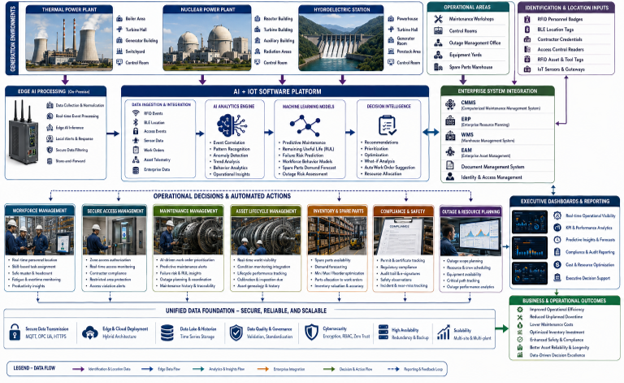
This workflow diagram illustrates how AI and IoT software transforms personnel identification, asset location, and operational data into maintenance, workforce, inventory, and asset lifecycle decisions across thermal, nuclear, and hydroelectric power generation facilities. It demonstrates the integration of RFID, BLE, Edge AI, machine learning, CMMS, ERP, and warehouse management systems to support predictive maintenance, outage planning, compliance reporting, spare parts optimization, and executive decision-making while improving operational efficiency and asset reliability.